New Toyota Fortuner Price and Positioning in the UAE Market

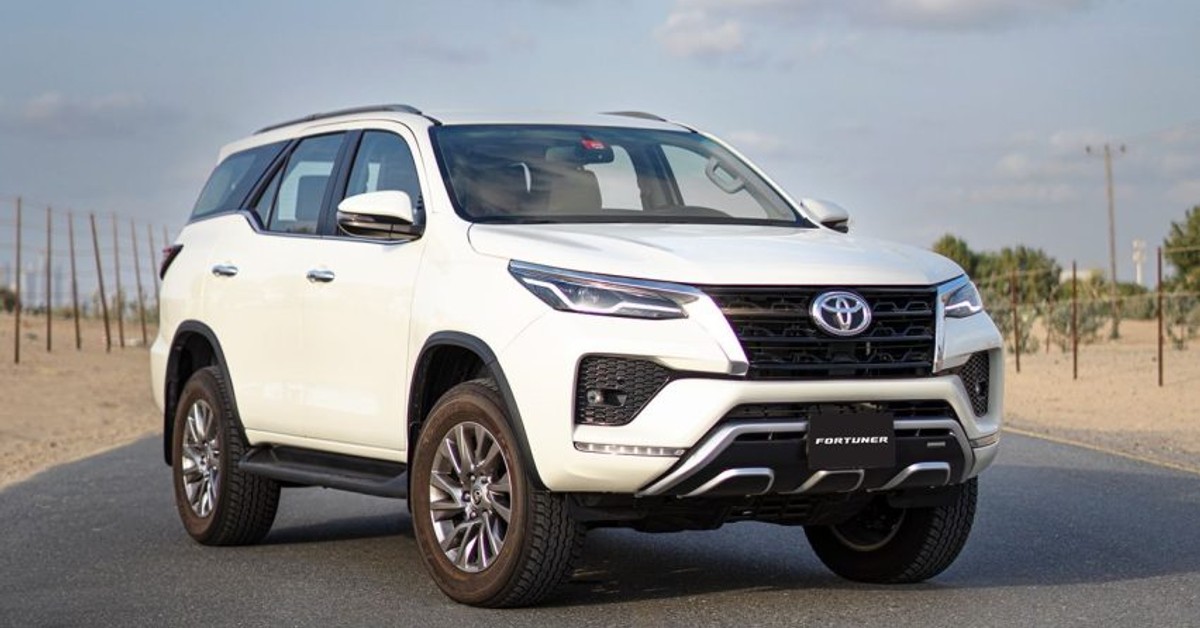
It goes without saying that the Toyota Fortuner remains one of the UAE’s most trusted family SUVs. With three rows and a 7‑seat configuration, the focus on toughness and long‑term dependability rather than cutting‑edge design or technology makes it a first‑choice favourite among families who want space and comfort. Looking at customer behaviour, most buyers don’t choose it because it feels new or luxurious but simply because of its practicality and proven track record in local conditions. From heat resistance to off‑road durability, the Fortuner has built a reputation that customers find hard to ignore.
KEY TAKEAWAYS
What are the powertrain options on the 2026 Toyota Fortuner in the UAE?
2.7L petrol and 4.0L V6 petrol enginesWhat is the price range of the 2026 Fortuner in the UAE?
Prices for the 2026 Toyota Fortuner in the UAE start from AED 128,900 for the base 2.7L EXR and go up to AED 173,900.What are the length and ground clearance of the Fortuner?
Length: 4,795 mm; ground clearance: 225 mmThat solid trust and tough‑image status are key to its market positioning in the UAE today. Most customers walking into the showroom know exactly what they are paying for: predictable ownership, strong resale value, easy servicing, and parts availability across the UAE. When pitched against newer rivals, it may not score high on features and tech, but for many buyers, the peace of mind far outweighs the missing gadgets. Hence, the Fortuner turns out to be a perfect pick for anyone who values reliability and long‑term value over modern flair.
Inside the 2026 Fortuner Breakdown
Your entry into this popular SUV starts at AED 128,900 for the 2.7L EXR. That’s the four‑cylinder petrol with 164 hp and 245 Nm of torque. If financed through Toyota’s finance plans, monthly payments start at AED 2,019 depending on down payment and tenure.
On the other hand, the 4.0L GXR is priced at AED 154,900 and comes with the V6 engine producing 235 hp and 376 Nm. While it is more expensive, it is also the most practical choice for most buyers who plan to keep the SUV for several years.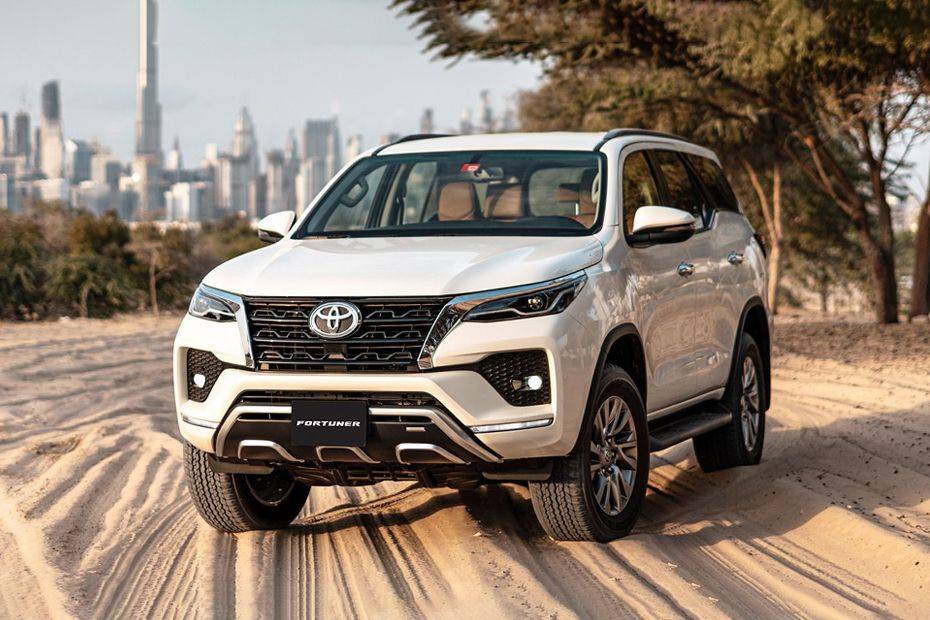
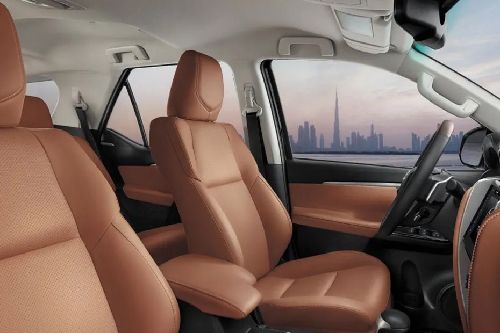
At the top end is the 4.0L VXR at AED 173,900. With this price premium, you get leather seats, ventilated front seats, and a 360‑degree camera. These upgrades enhance the interior experience with more comfort and a premium feel; the actual driving experience doesn’t change dramatically, which becomes clear during a test drive.
|
Variant |
Price (AED) |
Engine |
Power |
Key Features |
|
2.7L EXR |
128,900 |
2.7L 4-cyl |
164 hp |
17-inch alloys, 8-inch display, rear sensors, cruise control |
|
4.0L GXR |
154,900 |
4.0L V6 |
235 hp |
Paddle shifters, front/rear sensors, rear camera, navigation |
|
4.0L VXR |
173,900 |
4.0L V6 |
235 hp |
Leather, ventilated seats, 360 camera, blind spot warning |
Besides the brand prices, your actual on-road prices will go up further due to the mandatory costs. This includes registration, insurance for a seven-seater, and first service; you're looking at another AED 8,000 to AED 12,000 depending on your age and driving history.
Fortuner 2.7L: Real-World Truth
Based on our driving experience with the base 2.7L variant, it is perfectly adequate for everyday city traffic and normal daily use. On regular UAE roads, with full AC and five people on board, the engine handles the load without feeling weak. Remember, the SUV is a heavy, body‑on‑frame vehicle weighing around 2,100 kg, and real‑world fuel economy averages 9.0 - 9.5 km/l, which is not bad for such a large SUV.
But the real factor is drivability, which means merging onto Sheikh Zayed Road during rush hour requires careful gap planning. With the 2.7L, there is a lot to desire in terms of instant punch. In Dubai traffic, that hesitation can feel annoying and underwhelming.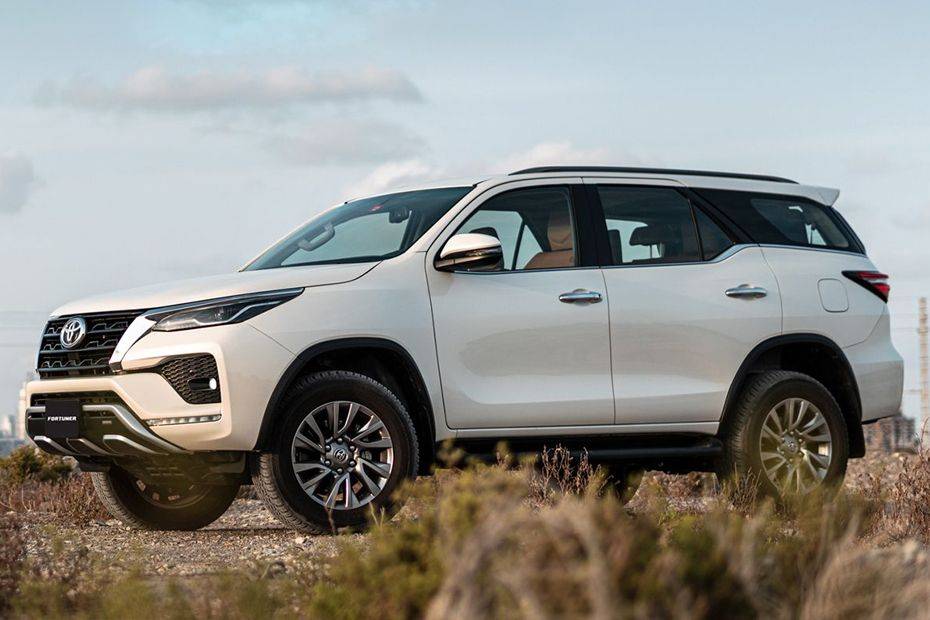
What makes the V6 the ideal pick?
If you move from the 2.7L to the 4.0L V6, it’s not hard to feel how the entire driving experience transforms. It is not dramatically faster, but you immediately feel the extra torque, jumping from 245 Nm to 376 Nm, which literally changes how the SUV feels in daily use.
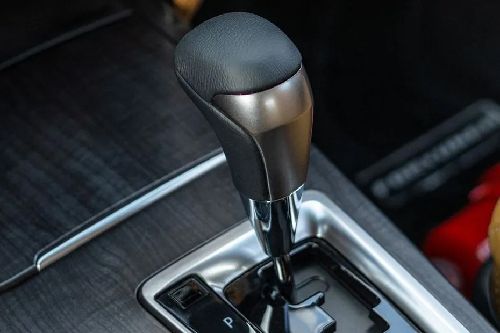
As expected, highway merges become effortless. For loaded desert trips, there is no need to plan gear changes, and the transmission never hunts; it just works very smoothly. Maintain moderate expectations on fuel economy, since the V6 averages around 8.5–9.0 km/l in mixed conditions. That comes at a premium of roughly AED 26,000 upfront and a loss of about 0.5–1 km/l. But in return, you get an SUV that feels far more capable and ready for any situation.
Cabin: Strengths and Weaknesses
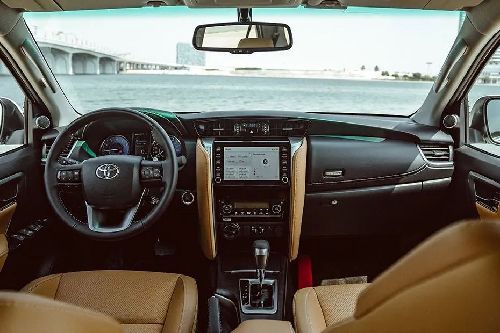
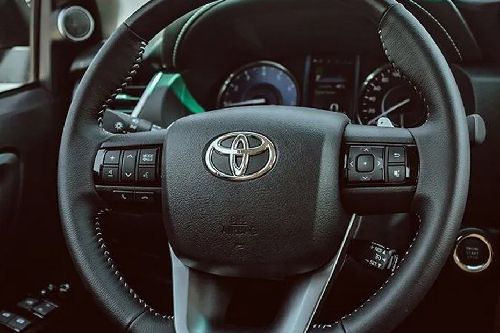
It has been over four years since Toyota facelifted the Fortuner, and in this time, the cabin has felt dated. By 2026 standards, the 8‑inch touchscreen is small, the plastic quality on the lower dashboard is average, and the infotainment feels like it’s from an earlier generation and is slow and overdue for an upgrade.
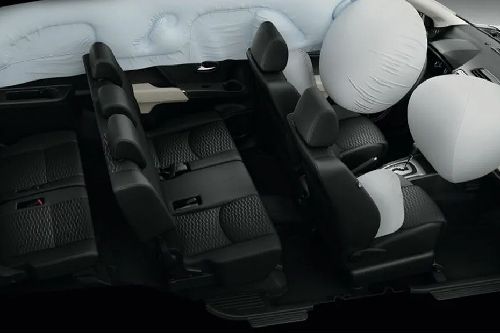
However, the seats are comfortable on long drives, the AC is powerful, and visibility is outstanding, thanks to the high seating position, large mirrors, and reasonably thin pillars. The third‑row space is tight for adults, but for kids it’s just fine. Boot space is 348 litres; many buyers know it’s small but work around it by folding the third row for usable cargo space.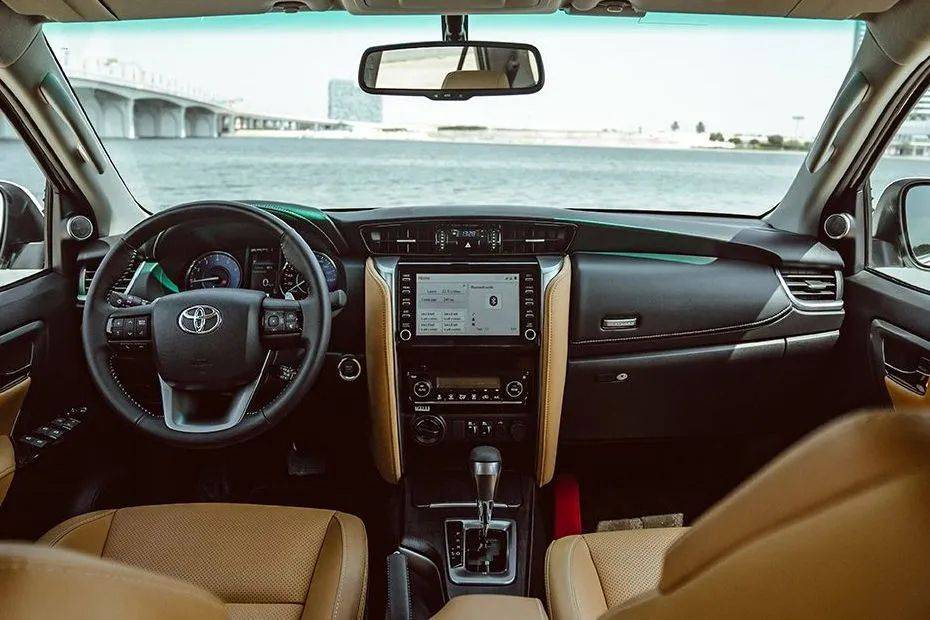
Fortuner Conquers the Desert
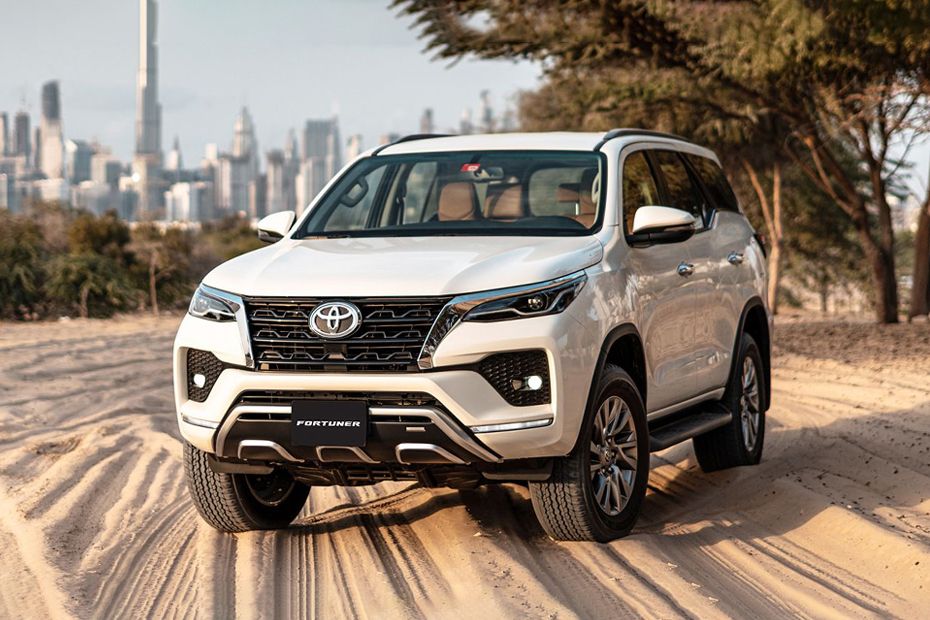
Now you understand why this SUV is a favourite: this is where the Fortuner earns its reputation. With body‑on‑frame construction, high ground clearance, and proper four‑wheel drive, it handles desert conditions without drama.
Drive through Fossil Rock and challenging dune areas near Sweihan with deflated tyres and 4H engaged, and it climbs without complaints. The chassis feels tough, and the suspension absorbs the terrain well. The unibody SUVs in this price range are more comfortable on roads but less confident off them. If you actually use desert capability regularly, that trade‑off is worth it. If you never go off‑road, you’re paying for an ability you don’t need, and that’s a clear distinction for buyers in the UAE.
Also, follow our guide on cruising your ride safely in the desert.
Look at the competition.
At AED 128,900, the Fortuner competes directly with the Hyundai Santa Fe (starting at AED 121,999) and the Nissan X‑Trail (starting at AED 101,900), both of which offer more modern interiors, better tech, and similar space. At AED 154,900 for the V6, it sits in the territory of the Ford Explorer (around AED 215,000) and the Hyundai Palisade (starting at AED 173,985), which feel more premium inside.
The Fortuner’s advantage is clearly not features or refinement. It’s resale value and perceived reliability, and in the UAE market, that matters greatly. Conservatively, a three‑year‑old Fortuner in good condition sells for about 65–70% of its original price, which is remarkable. Most rivals drop to 55–60% in the same period. On an AED 155,000 vehicle, that translates to an AED 15,000–25,000 difference in resale value.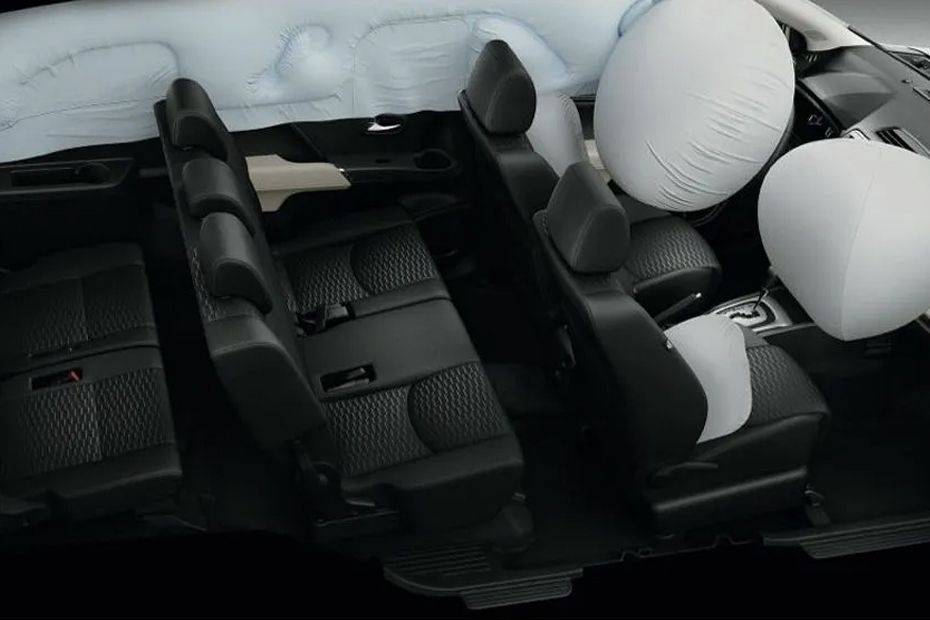
What about running costs?
At current UAE fuel prices (around AED 3.15/litre for Special 95) and averaging 9 km/l, fuel cost is about AED 35 per 100 km. Annual fuel for 20,000 km is around AED 7,000. Add insurance (roughly AED 3,500–5,500 per year) and services, and total running costs reach AED 12,000–15,000 per year before fuel.
Toyota’s dealer network across the UAE is extensive, so parts availability is excellent. Minor services cost around AED 450–550, while major services reach AED 1,200–1,500. Service intervals are every 10,000 km or 6 months. In Dubai’s heat and dust, more frequent servicing makes sense but increases ownership costs. Extended warranties are available and help protect resale value.
Three-year ownership costs
2.7L EXR:
- Depreciation: AED 38,900-43,900
- Running costs: AED 36,000-45,000
- Annual cost: AED 24,966-29,633
4.0L GXR:
- Depreciation: AED 44,900-49,900
- Running costs: AED 38,000-47,000
- Annual cost: AED 27,633-32,300
The V6 costs roughly AED 2,500-3,000 more yearly. Not huge over three years.
The real USP of the Fortuner is its build quality, which is solid and robust. You feel it when the doors close with authority, the chassis doesn’t flex or creak, and the panel gaps are consistent. There’s more road noise than in unibody rivals, though. The body‑on‑frame design creates a noisier cabin, so highway conversations at normal volume become harder. Also importantly, the suspension is firm. Unloaded, the rear can feel bouncy over speed bumps; once loaded with people, the ride settles. This is the reality of a truck‑based platform, and most owners accept it for the sake of durability.
Who Should Actually Buy It
Fortuner is a clear winner among buyers; it attracts certain types of customers who know what they want.
Buy if you:
- Actually use off-road capability regularly
- Plan to keep it 3-4 years minimum
- Value resale over features
- Need proven reliability for family use
- Drive in areas with limited service infrastructure
Skip if you:
- Never leave paved roads
- Want the latest tech and comfort
- Keep cars less than two years
- Prioritize smooth, quiet highway cruising
- Need genuine third-row adult space
The Variant Choice
It is always recommended to go for the 4.0L GXR if the budget allows; the V6 engine makes the SUV feel complete. The features like parking sensors, cameras, and navigation are genuinely useful in daily UAE driving.
The base 2.7L EXR works only if the budget is tight and the main use is city driving. The VXR adds luxury touches that don’t enhance off‑road capability or mechanical reliability. The GXR gives you about 95% of the overall experience for AED 19,000 less, which makes it a simple and clear choice for most buyers.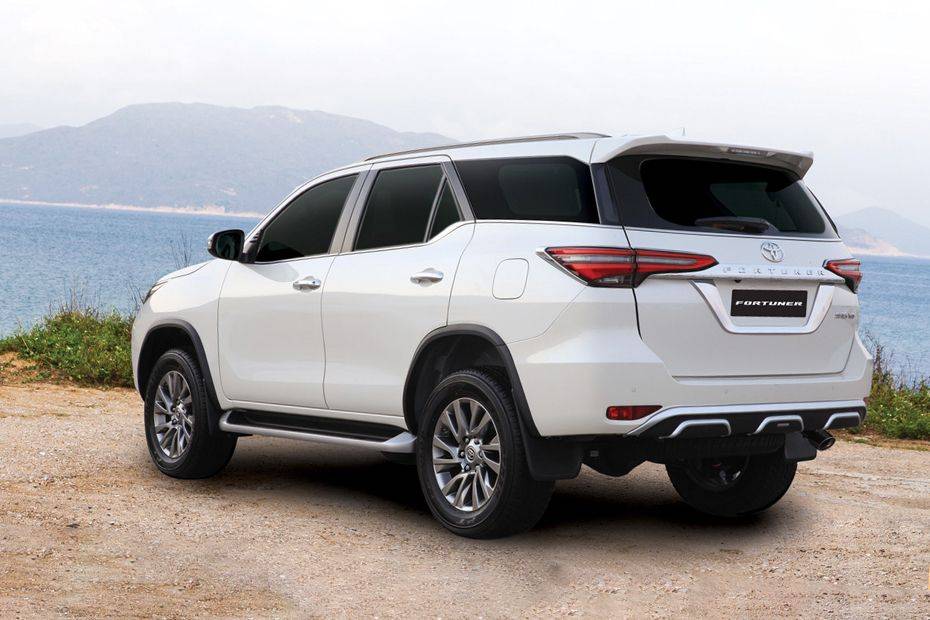
Market Positioning Reality
Toyota positions the Fortuner as a premium family SUV with off‑road capability. That’s accurate but incomplete. In Dubai, it has become a resale‑value hedge. Many UAE buyers purchase it knowing they can sell it easily later. Demand stays strong because previous owners had good experiences and made back most of their investment. This creates a self‑reinforcing cycle.
The Fortuner is not the best at anything specific. It’s not the most comfortable, most spacious, most efficient, or most advanced. But it’s good enough at everything that matters to UAE buyers, while holding value much better than alternatives. That’s not exciting, but for many Dubai families putting AED 130,000–170,000 into a seven‑seater, it’s exactly what they need. And with its sustained sales, strong demand, and loyal customer pull, it explains why it remains the leader in its segment.
Conclusion
The Fortuner’s pricing highlights the current market situation: you know you are paying for proven reliability and strong resale, not cutting‑edge features. At AED 128,900–173,900, it’s undeniably positioned competitively Even among the New Upcoming SUVs in 2026, but it is not a bargain, which is clear to buyers. The V6 variants justify their premium for most buyers through better power and stronger resale strength. If your main focus is getting most of the money back in three years, the Fortuner is the right choice.
Kiran Bajad

Kiran Bajad, a seasoned automotive journalist, writes with clarity and passion, helping readers make sense of a fast-changing car market. Drawing on years of road experience and a deep understanding of global trends, he turns complex industry shifts into practical guidance for everyday buyers.
Read Full Bio-
Explore Toyota Fortuner
-
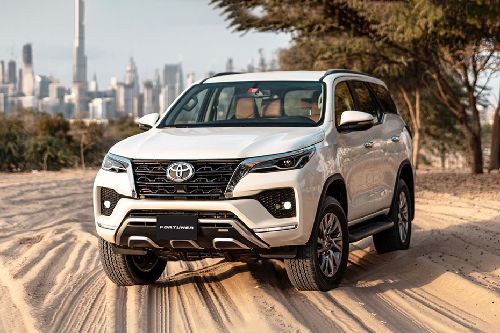
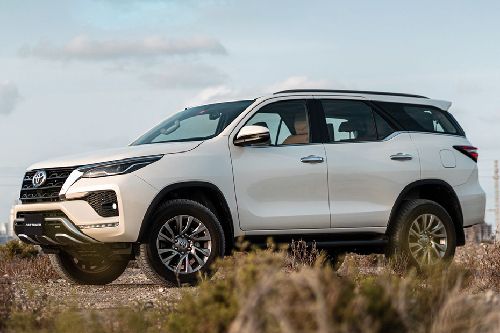
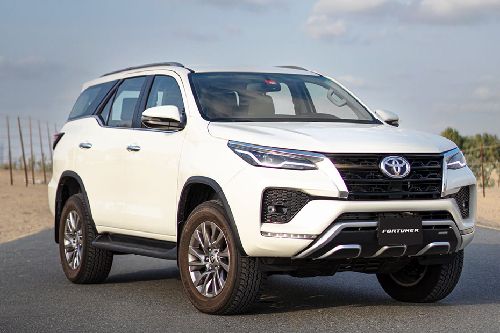
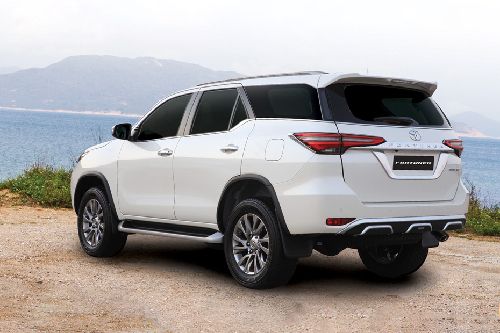
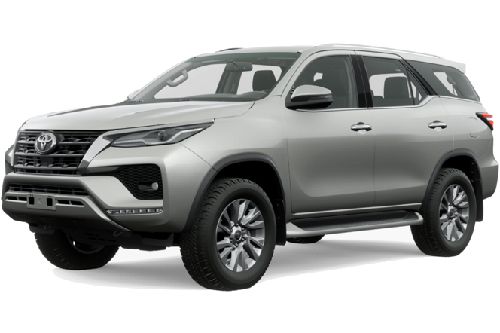

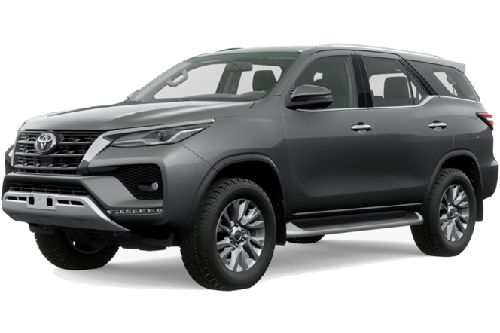
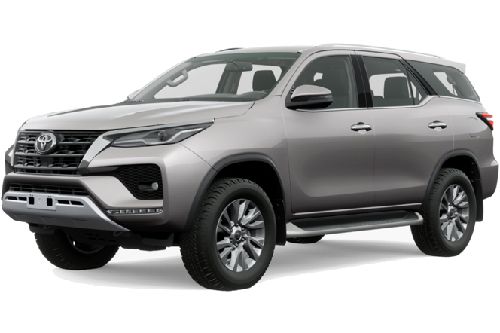
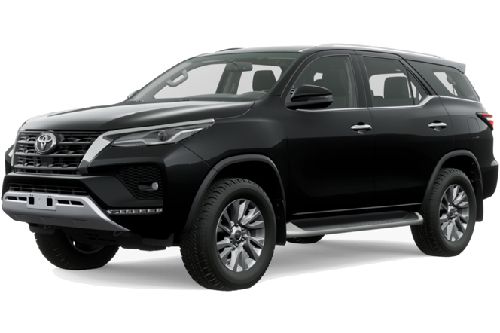
-
Toyota RAV 4 2026 -
Toyota Land Cruiser -
Toyota Fortuner -
Toyota Corolla -
Toyota Land Cruiser Prado -
Toyota Urban Cruiser -
Toyota Raize -
Toyota Yaris Sedan -
Toyota Corolla Hybrid -
Toyota Corolla Cross -
Toyota Supra -
Toyota Veloz
-
Back After 5 Years: How the 2026 Pajero Stacks Against Prado, Fortuner, Everest

-
Toyota vs Nissan vs Mercedes: Comparing UAE Dealer Service Speed
-
Two Years Into a New Hyundai Santa Fe: The Real Running Costs
-
AED 150,000 Budget: New Hyundai Santa Fe or Used Mercedes-Benz GLE?
-
Why That Geely Costs AED 3,000 More to Insure Than a Toyota




- Latest
- Popular




- News
- Featured Stories


- Latest
- Upcoming
- Popular
-
 Toyota Land Cruiser FJPrice coming soon
 -
-
-
-
-
-
 Alert Me When Launched
 -
 Alert Me When Launched
 -
 Alert Me When Launched
 -
 Alert Me When Launched
 -
 Alert Me When Launched
 -
 Alert Me When Launched
-
 2016 Toyota Fortuner02 Dec, 2015 . 48K views
 -
 2014 Toyota Fortuner 2.5G VNT MT DSL Review (Start Up, Interior, Exterior, Engine)25 Nov, 2015 . 86K views
 -
 TOYOTA FORTUNER EXTERIOR\INTERIOR-201125 Nov, 2015 . 16K views

|

|

|
|

|
|
Transmission
Automatic
|
Automatic
|
Automatic
|
Automatic
|
Automatic
|
|
Engine
2698
|
1975
|
1998
|
2497
|
1395
|
|
Power
164Hp/5200Rpm
|
243hp@6000rpm
|
250Hp@5500Rpm
|
277Hp@5800rpm
|
150hp@5000–6000rpm
|
|
Torque
244.18Nm/4000Rpm
|
353Nm@1500-4500rpm
|
390Nm@1750-4000rpm
|
421Nm@1700-4000rpm
|
250Nm@1500–3500rpm
|
|
|
- Latest
- Upcoming
- Popular
-
Toyota Land Cruiser FJPrice coming soon
-
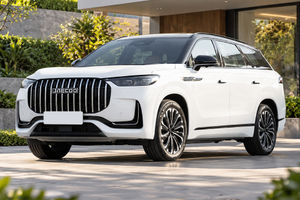 Jaecoo J8 SHSPrice coming soon
 -
-
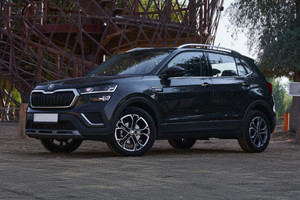 Skoda KushaqPrice coming soon
 -
-
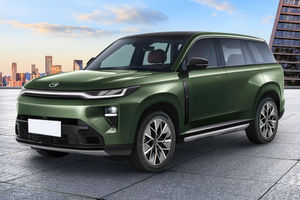
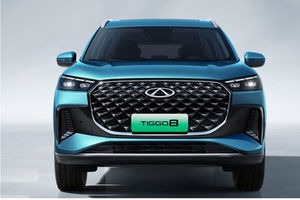 Chery Tiggo 8 HybridPrice coming soon
-
 Alert Me When Launched
 -
Alert Me When Launched
-
 Alert Me When Launched
 -
 Alert Me When Launched
 -
 Alert Me When Launched
 -
 Alert Me When Launched