The True Cost: How Much a Bigger Deposit Actually Saves You in the UAE


Abu Dhabi: Buying a new car is always a special event that promises freedom of mobility. Yet buying cars comes with a big financial commitment, but you can easily manage it with the right approach. Most buyers in the UAE have two decisions to make at the same time before actually getting into a dealership.
KEY TAKEAWAYS
What down payment do UAE banks usually require?
Typically 15 to 20 percent for new cars and around 20 to 25 percent for used cars.Does a bigger down payment lower the interest rate too?
Sometimes, a larger down payment reduces risk for the bank, which can unlock a better rate.First, how much cash to put down upfront. Second, how much to borrow from the bank. These are two different decisions, but most buyers treat them as one, putting down whatever amount is needed to get the loan approved and then moving on. That approach misses something worth knowing.
The size of a down payment does not just determine loan approval; it shapes the entire loan that follows, including the interest paid over five years, the monthly instalment, and the total amount handed over by the time the car is fully owned. Here is what you should consider before making that decision.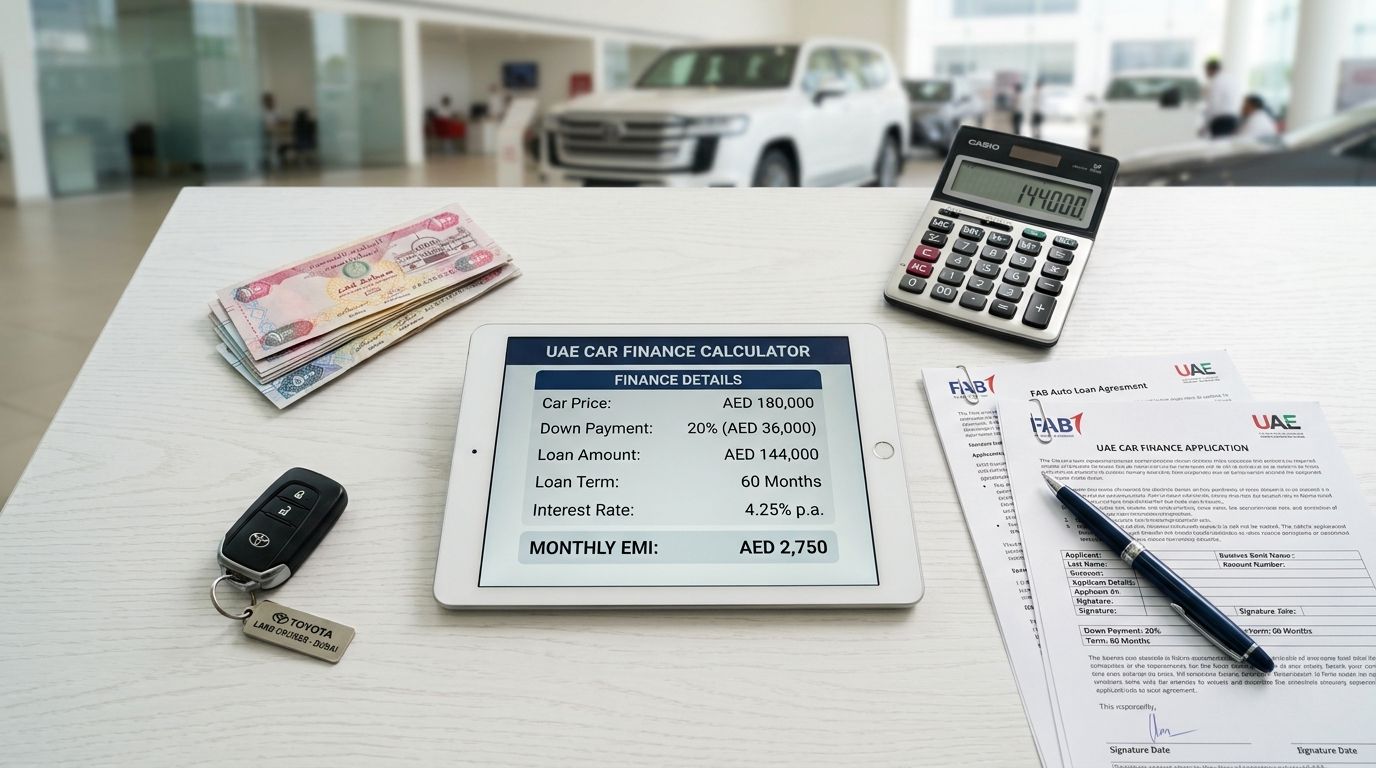
The real calculations
A down payment that is AED 5,000 larger reduces both the loan principal and the interest calculated against that smaller balance. Over a five-year term, that modest increase in upfront cash can translate into AED 8,000 to 15,000 in interest saved, depending on the rate charged, with the lower monthly payment on top, meaning money that stays in your account every single month rather than going towards interest.
|
Down Payment |
Amount Financed (on an AED 100,000 car) |
Approximate Interest Impact Over 5 Years |
|
15% (AED 15,000) |
AED 85,000 |
Baseline |
|
20% (AED 20,000) |
AED 80,000 |
A few thousand dirhams less |
|
30% (AED 30,000) |
AED 70,000 |
Considerably more, especially at higher rates |
|
40% (AED 40,000) |
AED 60,000 |
Largest saving, though it ties up more cash upfront |
As the table highlights, the exact figures shift depending on the rate a buyer qualifies for, but the direction never changes. Financing less always costs less in interest, and that difference grows at UAE rates of 2.5 to 7%, depending on whether the car is new or used. 
Most Buyers Skip It
It is often noticed that despite how clear this calculation is and the obvious benefits, most UAE buyers never actually run it. They put down what feels affordable at the time and accept whatever loan structure the bank offers next. The gap between that approach and a deliberate down-payment strategy is exactly where the real savings are, and it is a gap almost nobody closes without being told about it first.
The Monthly Payment
Beyond the total interest saved, a bigger down payment directly reduces the monthly instalment, which is just as important for everyday budgeting as the headline interest figure. A buyer financing AED 70,000 instead of AED 85,000 over the same 60-month term pays a considerably lower EMI every single month, freeing up cash for fuel, insurance, and Salik that would otherwise get squeezed by a tighter loan repayment.
- A lower loan amount reduces both the principal and the interest charged on it, a double saving explored in our guide to the best car loan and EMI options in the UAE, a double saving that many buyers underestimate when they first sit down with a bank.
- Some banks offer marginally better rates to buyers putting down more than the minimum, treating a larger down payment as a signal of lower risk.
- A smaller loan balance also means less exposure if the car needs to be sold or traded in early, since the gap between what is owed and what the car is worth stays smaller throughout the loan.

The Trade-Off
But keep in mind that none of this means maxing out a down payment is automatically the right move for every buyer. Putting more cash into a car upfront means less liquidity for emergencies, other investments, or simply day-to-day breathing room, and that trade-off is real.
If you have irregular income, such as those relying on commission or a variable salary, you may be better served keeping cash reserves intact rather than stretching for a bigger down payment. Money put into a down payment also stops earning any return elsewhere. Therefore, buyers with access to better-performing investments should weigh that opportunity cost fairly rather than assuming a bigger down payment is always the smarter financial move.
A down payment beyond what a bank requires only helps if the buyer can actually afford it without straining other obligations, since a missed loan payment does far more damage to credit standing than a slightly higher interest bill ever would.
The smart choice
For most buyers, the best option is somewhere between the minimum a bank requires and the maximum they could technically afford. Putting down 25 to 30 per cent instead of the minimum 15 to 20% tends to considerably reduce both the interest paid and the monthly instalment without leaving a household with zero financial cushion. It is worth running the actual numbers with a bank's EMI calculator before deciding, since the difference between 20 percent and 30 percent down on the same car can be a real amount of money saved over five years, not a marginal rounding error.
In Practice
- A buyer stretching to the bare minimum down payment on a new car should expect the highest monthly instalment and the most interest paid over the loan term, a trade-off worth accepting only if cash flow truly requires it.
- A buyer able to comfortably put down 25 to 30%, without touching emergency savings, is generally in the best position to benefit from this calculation.
- A buyer with access to investment returns higher than the loan's interest rate has a legitimate reason to keep the down payment closer to the minimum and invest the difference instead.

Key Takeaway
So coming back to the headline, a bigger down payment is one of the few controllable levers a buyer actually has over the total cost of financing a car in the UAE.
It certainly lowers the amount borrowed, reduces the interest charged on that amount, shrinks the monthly instalment, and can occasionally unlock a slightly better rate altogether. But again, everything is contextual, and hence you should consider specifically your personal financial situation before making the decision.
What it does mean is that the down payment deserves the same careful thought as the interest rate itself, rather than being treated as a hurdle to clear before getting to the part of the decision that actually matters.
Kiran Bajad

Kiran Bajad, a seasoned automotive journalist, writes with clarity and passion, helping readers make sense of a fast-changing car market. Drawing on years of road experience and a deep understanding of global trends, he turns complex industry shifts into practical guidance for everyday buyers.
Read Full Bio-
Toyota Fortuner -
Toyota RAV 4 2026 -
Toyota Land Cruiser -
Toyota Corolla -
Toyota Land Cruiser Prado -
Toyota Urban Cruiser -
Toyota Yaris Sedan -
Toyota Raize -
Toyota Corolla Hybrid -
Toyota Corolla Cross -
Toyota Supra -
Toyota Camry
- Latest
- Popular


- News
- Featured Stories


- Latest
- Upcoming
- Popular
-
-
-
 Toyota Land Cruiser FJPrice coming soon
 -

-
-
-
 Alert Me When Launched
 -
 Alert Me When Launched
 -
 Alert Me When Launched
 -
 Alert Me When Launched
 -
 Alert Me When Launched
 -
 Alert Me When Launched
-
 Toyota Granvia30 Apr, 2026 .
 -
 Toyota Liteace30 Apr, 2026 .
 -
 Toyota Veloz30 Apr, 2026 .
 -
 Toyota Highlander30 Apr, 2026 .
 -
 Toyota Supra30 Apr, 2026 .
 -
 Toyota GR Corolla Overview12 Mar, 2026 .
 -
 The all-new Toyota Urban Cruiser03 Oct, 2025 .
 -
 The All-New 2024 Toyota Land Cruiser Prado03 Oct, 2025 .
 -
 2016 Toyota Land Cruiser Prices in the UAE04 Dec, 2015 . 84K views
 -
 2016 Toyota Land Cruiser - Ultimate In-Depth Look in 4K04 Dec, 2015 . 7K views