How a Bigger Down Payment Can Save You Thousands

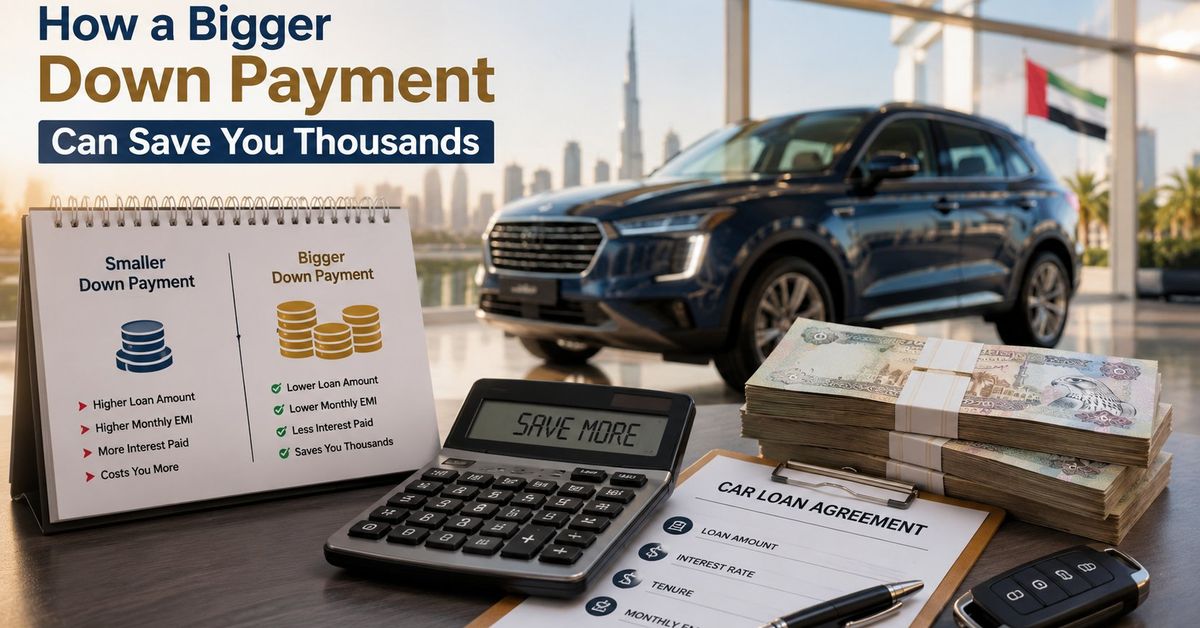
Abu Dhabi: When preparing to buy a new car in the UAE, buyers make two decisions at the same time: how much cash to put down upfront and how much to borrow from the bank. While these are two different decisions, most car buyers treat them as one, as they simply think of putting down enough to qualify for the loan.
KEY TAKEAWAYS
What down payment do UAE banks usually require?
Typically is 15 to 20 percent for new cars and around 20 to 25 percent for used cars.Does a bigger down payment lower the interest rate too?
Sometimes. A larger down payment reduces risk for the bank, which can unlock a better rate.This approach misses a critical reality, as the size of that down payment does not simply determine loan approval. It basically underlines the whole loan process, which includes the interest accrued over five years, the monthly payment, and the total amount paid by the time the car is fully owned.
The calculation is rather harsh; a down payment that is AED 5,000 larger reduces not just the loan principal but also the interest calculated on that smaller amount. Over a five-year term, that seemingly modest increase in upfront capital can translate to AED 8,000 to 15,000 in interest saved. Add the lower monthly payment into the equation, money that stays in your wallet each month, and the savings compound further.
Despite this, most UAE buyers do not necessarily perform these calculations. They deposit what they believe they can afford at the time, then accept whatever loan structure follows. The difference between that approach and a deliberate strategy built around the down payment can save you considerably. Here is what matters.
The Basic Mechanics
A car loan charges interest, whether flat or reducing, on the amount actually borrowed. Every dirham paid upfront is a dirham on which the bank does not charge interest. On a straightforward flat-rate loan, that relationship is simple to see.
|
Down Payment |
Amount Financed (on a AED 100,000 car) |
Rough Interest Saved Over 5 Years |
|
15% (AED 15,000) |
AED 85,000 |
Baseline |
|
20% (AED 20,000) |
AED 80,000 |
A few thousand dirhams less |
|
30% (AED 30,000) |
AED 70,000 |
Noticeably more, especially at higher rates |
|
40% (AED 40,000) |
AED 60,000 |
Largest saving, though it ties up more cash upfront |
The exact figures shift depending on the rate a buyer qualifies for, but the direction never changes. Financing less always costs less in interest, and the difference compounds noticeably at UAE rates of 2.5 to 7 percent as detailed in our guide to car loan interest rates and eligibility in the UAE depending on whether the car is new or used. 
Lowers Monthly Payment
Beyond the total interest saved, a bigger down payment directly shrinks the monthly instalment, which matters just as much for day-to-day budgeting as the headline cost does.
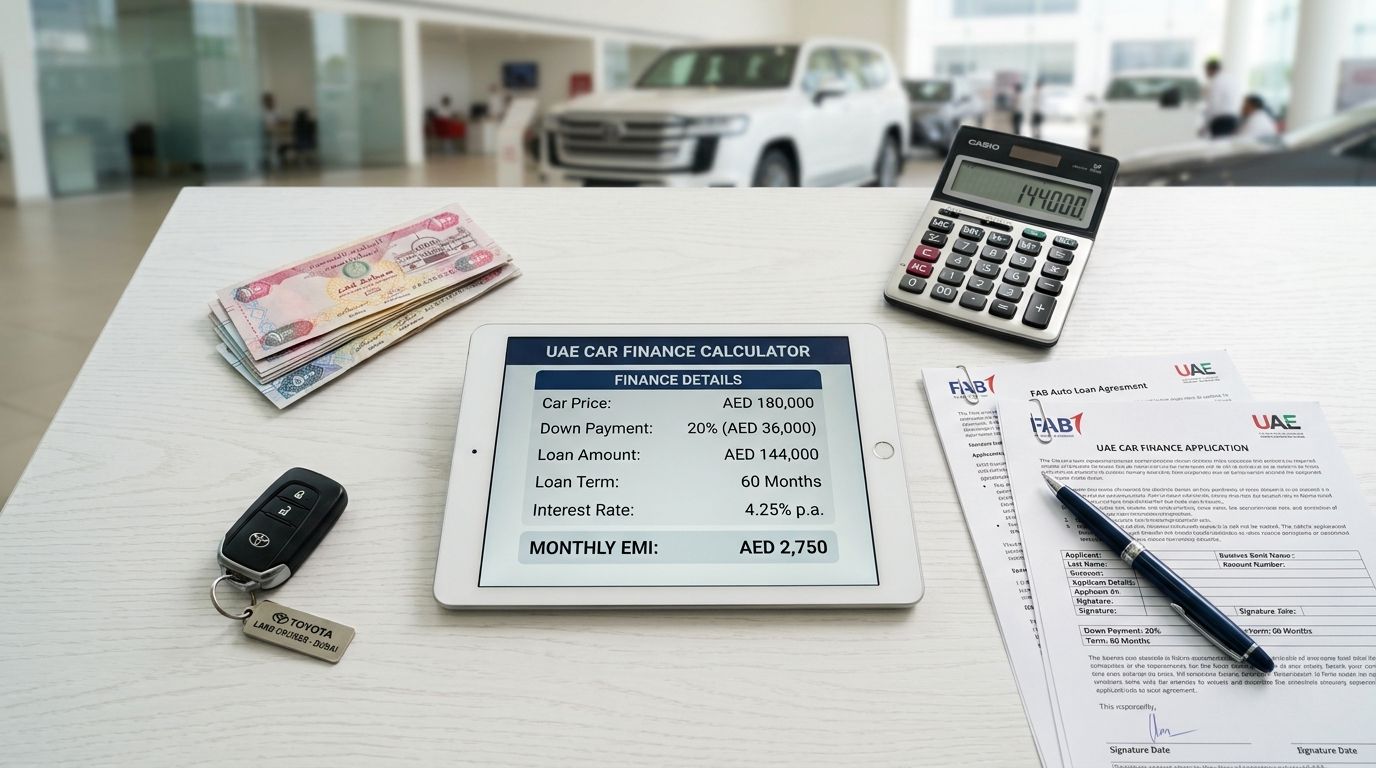
A buyer financing AED 70,000 instead of AED 85,000 over the same 60-month term pays a noticeably lower EMI every month, freeing up cash for fuel, insurance, and Salik that would otherwise be squeezed by a tighter loan repayment.
- A bigger down payment reduces the loan principal and the interest charged on it, a double saving that a lot of buyers underestimate.
- Some banks offer marginally better rates to buyers putting down more than the minimum, treating a larger down payment as a signal of lower risk.
- A smaller loan balance also means less exposure if the car needs to be sold or traded in early, since the gap between what is owed and what the car is worth stays smaller throughout the loan.

The Trade-Off
None of this means maxing out the down payment is automatically the right move for every buyer. Putting more cash into a car upfront means less liquidity for other investments or simply less day-to-day breathing room.
- Buyers with irregular income, such as those who rely on commission or a variable salary, may be better off keeping cash reserves intact rather than stretching for a bigger down payment.
- Money put into a down payment stops earning any return elsewhere, so buyers with access to better-performing investments should weigh that opportunity cost honestly rather than assuming a bigger down payment is always the smarter financial move.
- A down payment beyond what a bank requires only helps if the buyer can actually afford it without straining other financial obligations, since a missed loan payment does far more damage to credit standing than a slightly higher interest bill ever would.

A Practical Middle Ground
For most buyers, the best option is somewhere between the minimum a bank requires and the maximum they could afford. Putting down 25 to 30 percent instead of the minimum 15 to 20 percent is likely to reduce both the interest paid and the monthly payment.
It is worth running the actual numbers with a UAE car finance calculator for monthly payments before deciding, since the difference between a 20 percent and a 30 percent down payment on the same car can be a real amount of money saved over five years.
Conclusion
So it is a no-brainer that a bigger down payment is one of the few real ways to reduce the total cost of financing a car in the UAE. It lowers the loan amount, reduces the interest charged on that amount, drops the monthly instalment, and may also help you secure a slightly better rate altogether.
Having said that, none of that means every buyer should stretch to put down as much as possible, since keeping some cash in reserve matters too. What it does mean is that the down payment deserves the same careful thought as the interest rate itself, rather than being treated as a hurdle to clear before getting to the part of the decision that actually matters.
Also Read: Which UAE Banks Offer the Cheapest Car Loans in 2026?
Kiran Bajad

Kiran Bajad, a seasoned automotive journalist, writes with clarity and passion, helping readers make sense of a fast-changing car market. Drawing on years of road experience and a deep understanding of global trends, he turns complex industry shifts into practical guidance for everyday buyers.
Read Full Bio-
Nissan Patrol -
Nissan X-trail -
Nissan X-terra -
Nissan Kicks -
Nissan Magnite -
Nissan Pathfinder -
Nissan Altima -
Nissan Patrol Nismo -
Nissan Urvan -
Nissan Z
- Latest
- Popular
- News
- Featured Stories
- Latest
- Upcoming
- Popular
-
 Alert Me When Launched
 -
 Alert Me When Launched
 -
 Alert Me When Launched
 -
 Alert Me When Launched
 -
 Alert Me When Launched
 -
 Alert Me When Launched
-
 Nissan Urvan29 Apr, 2026 .
 -
 Nissan Patrol Nismo01 Nov, 2025 .
 -
 Nissan X-Trail01 Nov, 2025 .
 -
 All New Nissan KICKS 2025 | Arabic01 Nov, 2025 .
 -
 All New Nissan Z Nismo01 Nov, 2025 .
 -
 NISSAN PATROL CCL01 Nov, 2025 .
 -
 Nissan Magnite Walk Around | Arabic01 Nov, 2025 .
 -
 2017 Nissan 370Z04 Jan, 2018 .
 -
 2017 Nissan Navara Pickup04 Jan, 2018 .
 -
 2017 Nissan GT-R Review04 Jan, 2018 .