Buying Used Car Parts in the UAE: What to Check, What to Avoid, and What the Law Says

- KEY TAKEAWAYS
- Why Consider Used Parts?
- The Main Benefits of Buying Used Auto Parts in the UAE
- How to Identify Quality Used Parts and What Buyers Should Check
- The Key Differences Between OEM, Aftermarket, and Used Parts
- Essential Tips to Avoid Scams and Unreliable Sellers
- Sourcing Options and Where to Buy Used Auto Parts in the UAE
- What to do When a Specific Part is Hard to Find
For owners of vehicles outside the manufacturer's warranty, the used parts market offers significant cost savings, but navigating it requires an understanding of UAE law and a careful eye for quality.
KEY TAKEAWAYS
Is it legal to use used car parts in the UAE?
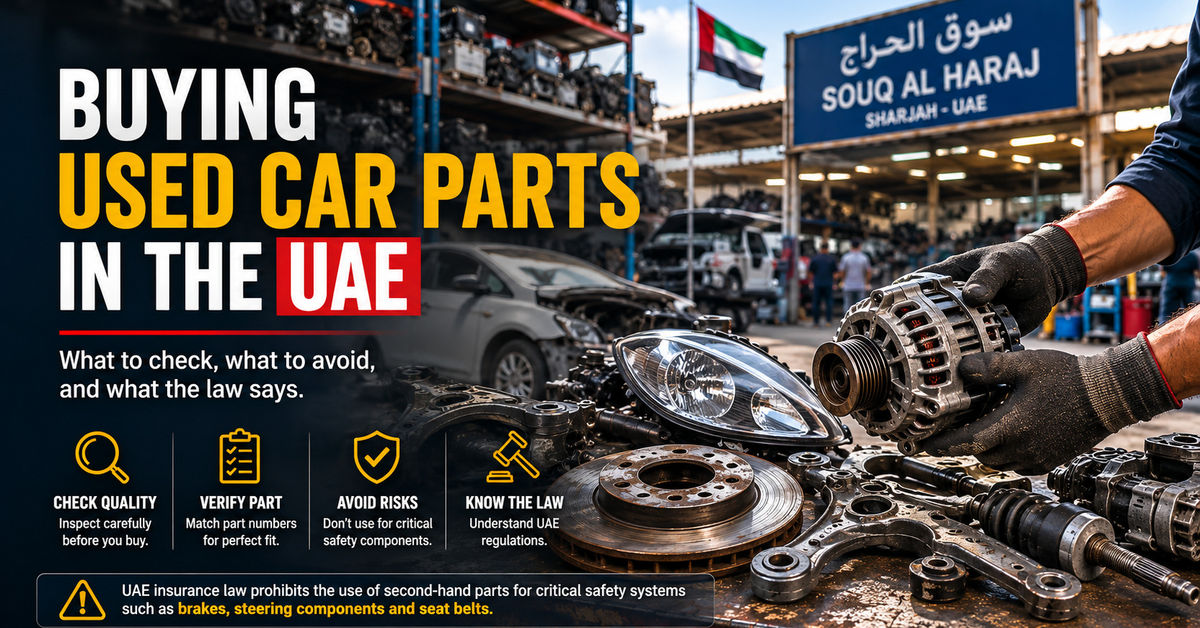
Yes, but used parts are prohibited for certain safety-critical components, including brakes, steering parts and seat belts.What should I check before buying used car parts?
Check for damage, corrosion and wear, and always verify the part number and compatibility.Where can I buy used car parts in the UAE?
Major hubs include Sharjah’s Souq Al Haraj, Dubai’s Ras Al Khor and Al Aweer, and Abu Dhabi’s Mussafah.In a region where vehicles are often kept on the road for many years, maintaining an older car is a practical reality for thousands of owners. Once a manufacturer's warranty expires, the cost of agency-supplied original parts can become a significant financial burden. This is where the expansive used auto parts market in the UAE provides an alternative, offering everything from body panels to engine components at a fraction of the cost of new. The trade-off, however, involves navigating a complex landscape of quality, authenticity, and strict legal regulations governing which parts can and cannot be reused.
Quick read:
- The primary driver for buying used parts is cost saving, especially for vehicles over five years old where insurance depreciation on parts can reach 30 percent.
- UAE insurance law strictly prohibits the use of second-hand parts for critical safety systems like brakes, steering components, and seat belts.
- Physical inspection is crucial; buyers must check for cracks, wear, and correct part numbers before making a purchase.
- Major sourcing hubs are concentrated in Sharjah's Souq Al Haraj and industrial areas, Dubai's Ras Al Khor, and Abu Dhabi's Mussafah zone.
Why Consider Used Parts?
For many car owners, the decision to seek out used parts is a matter of pure economics. As a vehicle ages, its market value declines, making it difficult to justify spending thousands of dirhams on brand-new components from the official dealer, particularly for cosmetic items or non-critical mechanical parts. The daily commute, family transport, and the general wear from the GCC climate mean that repairs are an inevitable part of long-term ownership. The used parts market bridges this gap, providing a cost-effective way to keep cars safe and roadworthy without incurring expenses that might exceed the vehicle's worth. It is not just about saving money; it is about sustainable vehicle maintenance in a market where cars have a long service life.
The Main Benefits of Buying Used Auto Parts in the UAE
The financial advantage is the most direct benefit. A used door, bonnet, or headlamp assembly can be sourced for a small fraction of the agency price. This is particularly relevant when dealing with insurance claims for older vehicles. According to the CBUAE Unified Motor Vehicle Insurance Policy, depreciation is applied to the value of spare parts for private cars after the first year of registration. This is a structured system. While there is no depreciation in the first year, it climbs steadily thereafter.
The official schedule is clear:
- Second year: 5% depreciation
- Third year: 10% depreciation
- Fourth year: 15% depreciation
- Fifth year: 20% depreciation
- Sixth year and onwards: 30% depreciation
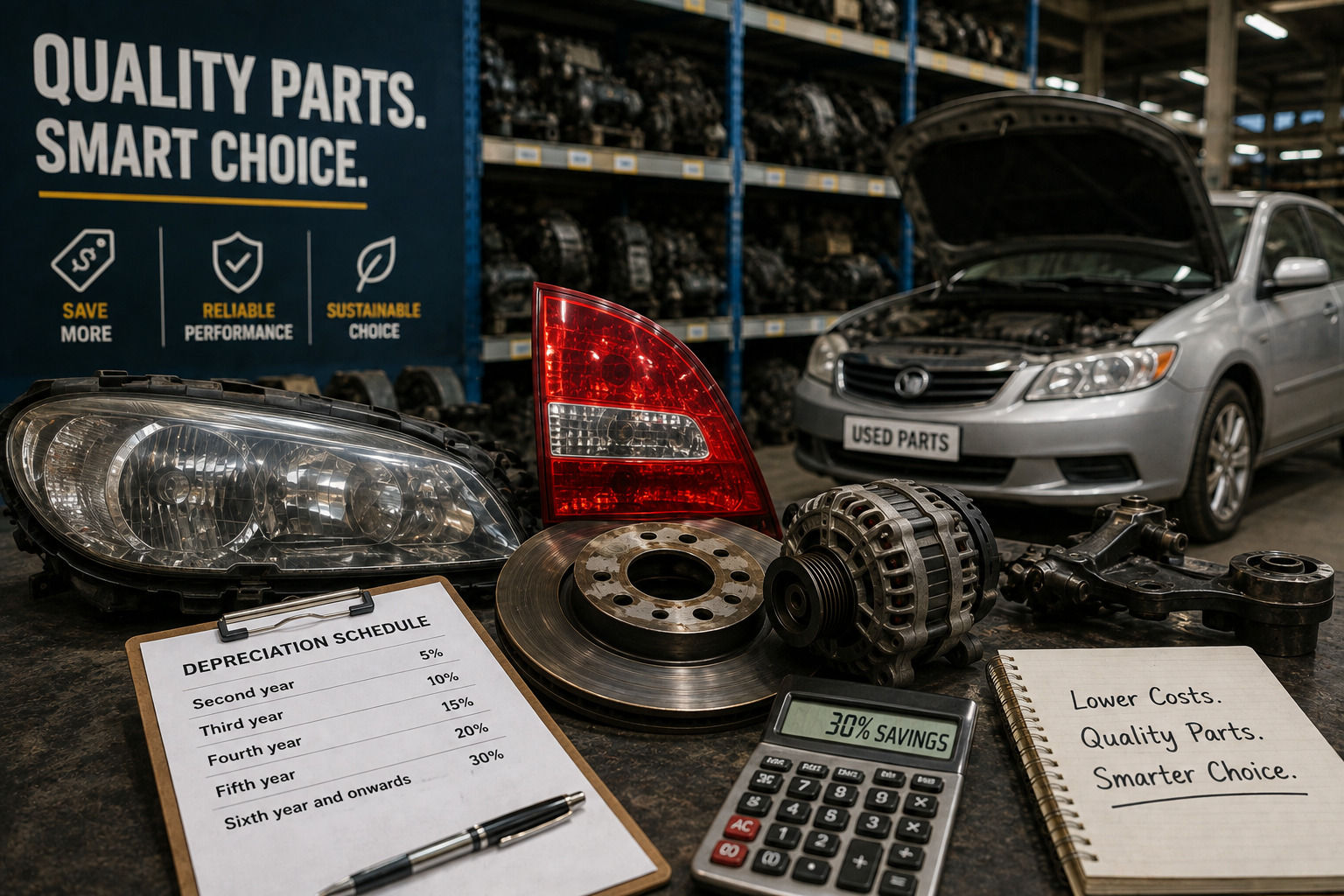
This means that for a six-year-old car, an insurance payout for a damaged part will be reduced by 30%, leaving the owner to cover the shortfall. Sourcing a quality used part often aligns the repair cost more closely with the actual insurance payout, minimising out-of-pocket expenses.
How to Identify Quality Used Parts and What Buyers Should Check
Purchasing used parts isn't like buying new; due diligence is essential. The first step is a thorough physical inspection. For mechanical parts like alternators or water pumps, check for excessive corrosion, cracks in the housing, or signs of previous repair like fresh sealant. Spin any pulleys by hand to feel for rough or noisy bearings. For body panels, look for hidden dents, deep scratches that have gone through the paint, or signs of body filler, which suggest a previous poor-quality repair. It is vital to bring the old part with you for a direct comparison or, at a minimum, have clear photos and the exact part number from the original component. Mismatched parts are a common and costly mistake.
Crucially, buyers must be aware of what the law forbids. Under Insurance Authority Decision 25/2016, certain safety-critical components must never be replaced with used parts. The prohibited list is specific and non-negotiable. It includes all glass, brake master and wheel cylinders, brake calipers and hoses, steering boxes and racks, steering ball joints, and all seat belts. Attempting to fit a used part from this list is not only illegal but also a serious safety risk.
The Key Differences Between OEM, Aftermarket, and Used Parts
The terminology in the parts market can be confusing, but understanding the differences is key to making an informed decision. Each category has its place, and UAE insurance regulations acknowledge this distinction. For vehicles under one year old, repairs must use new original parts from the agency. After one year, insurers are permitted to use non-original parts of a similar grade.
|
Part Type |
Description |
Common Use Case |
|
Genuine / OEM |
Original Equipment Manufacturer. The exact same part that was fitted at the factory, sold in branded packaging by the car's official dealer. |
Warranty repairs, newer vehicles, or when perfect fit and performance are required. |
|
OES |
Original Equipment Supplier. A part made by the same company that supplies the car manufacturer, but sold in the supplier's own packaging (e.g., Bosch, Denso). Often identical to OEM but cheaper. |
Post-warranty servicing where quality is important but agency prices are to be avoided. |
|
Aftermarket |
A part made by a third-party company that was not the original supplier. Quality can range from excellent to very poor. |
Performance upgrades, budget repairs, or common replacement items like filters and brake pads. |
|
Used / Salvage |
An original part taken from another vehicle, usually one that has been written off in an accident. |
Replacing body panels, interior trim, or major components on older vehicles where new parts are too expensive. |
Essential Tips to Avoid Scams and Unreliable Sellers
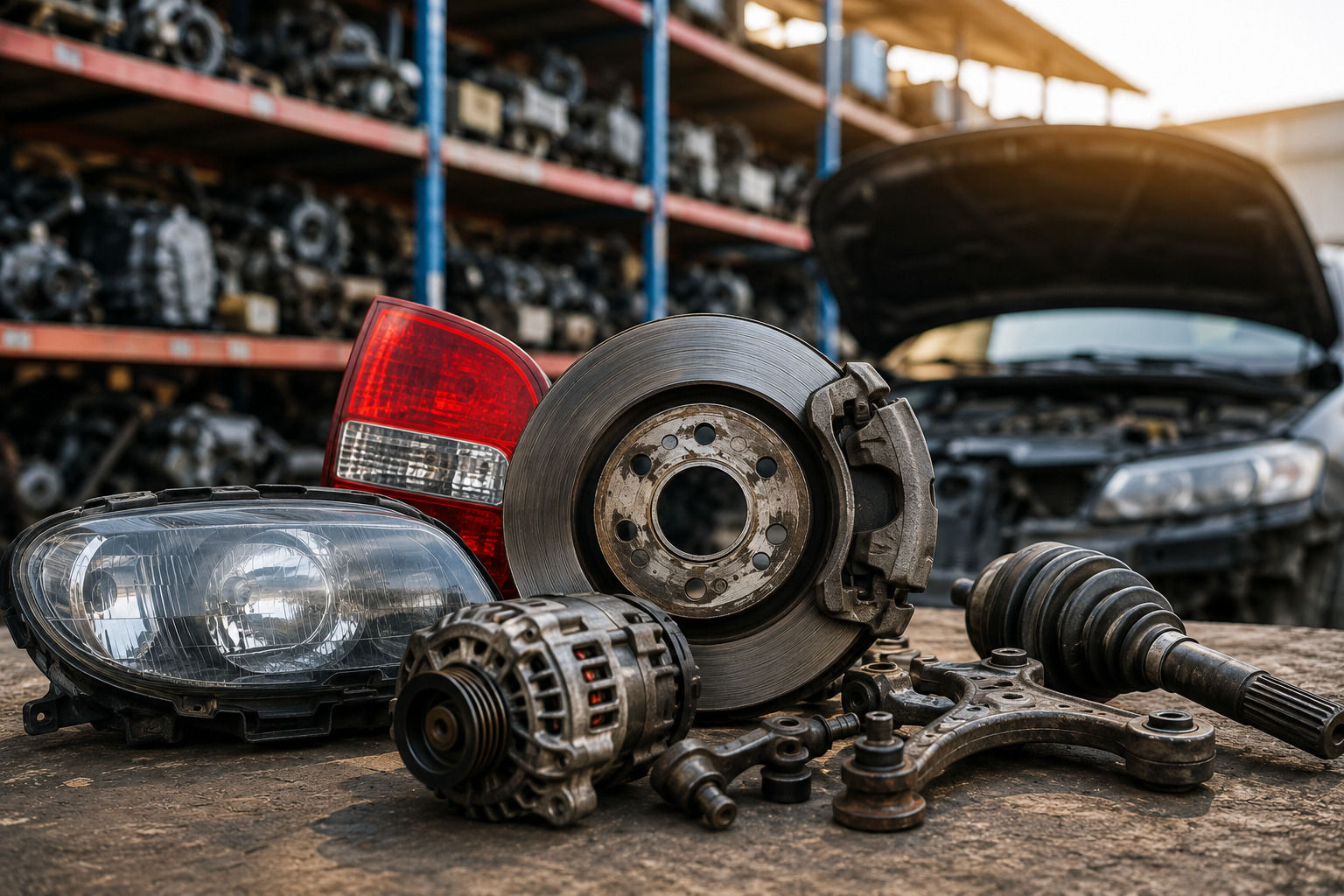
The scale of the counterfeit parts problem in the UAE is significant. In 2024 alone, authorities seized over 2.5 million fake auto parts valued at approximately AED 7.46 million in a series of raids. These parts often look identical to genuine ones but are made from substandard materials and can fail catastrophically. To protect yourself, be wary of prices that seem too good to be true. A genuine OEM part being offered at a 90% discount from a non-official source is a major red flag.
Always try to buy from established sellers with a physical shop or warehouse. Inspect the part in person rather than relying on photos. Check for poor-quality packaging, spelling mistakes on labels, or logos that don't look quite right. Reputable sellers will offer a receipt and often a limited warranty or exchange period if the part is found to be defective. Under Federal Decree-Law 42 of 2023 on commercial fraud, selling counterfeit goods is a serious offence. If a deal feels suspicious, it is better to walk away.
Sourcing Options and Where to Buy Used Auto Parts in the UAE
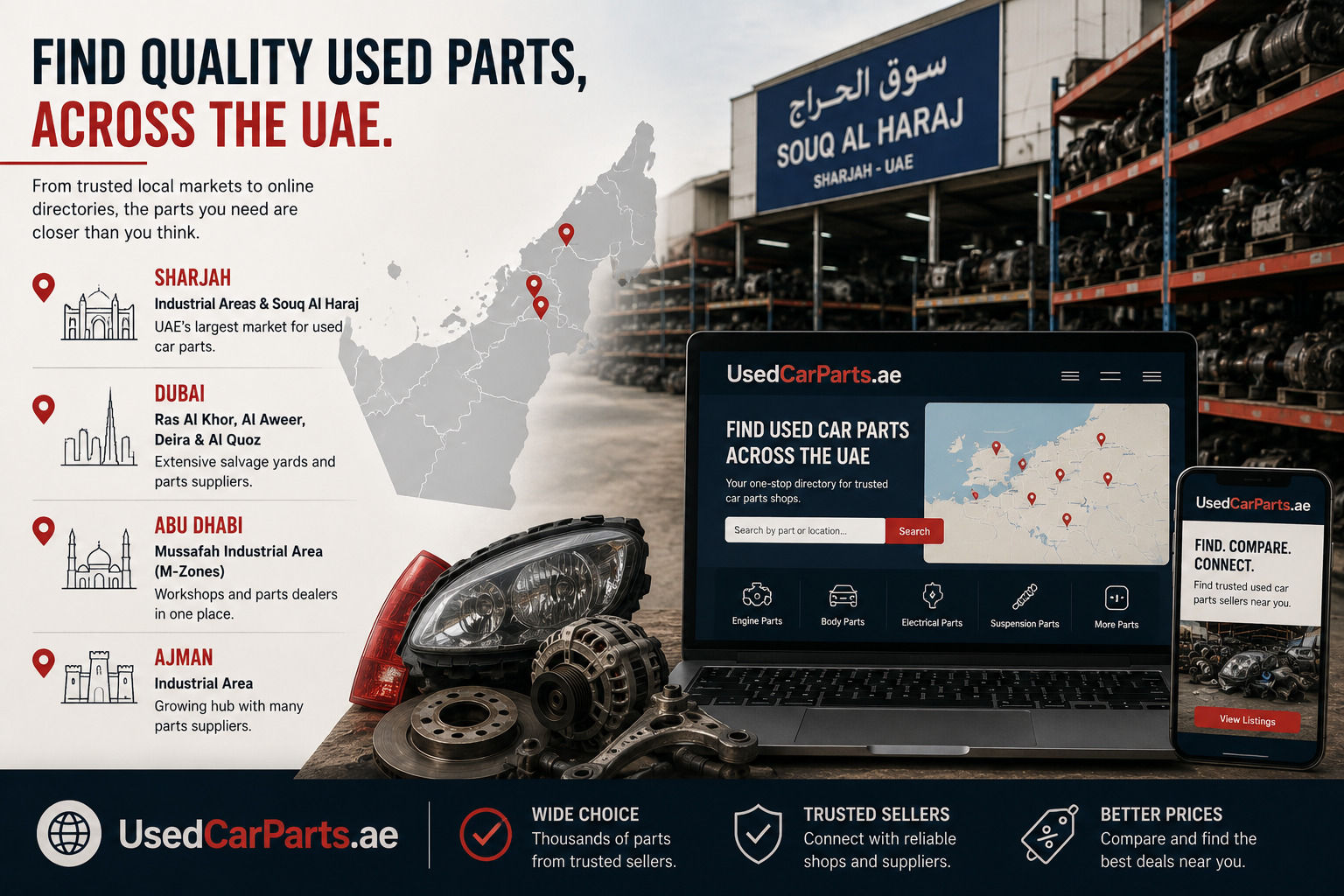
The UAE has several well-established hubs for sourcing used car parts, with Sharjah being the largest. The emirate's Industrial Areas and the newer Souq Al Haraj are vast marketplaces dedicated to used cars and parts. Opened in January 2021, Souq Al Haraj is a modern, organised facility off the E311, spanning over 3 million square feet and hosting hundreds of traders.
In Dubai, the key areas are Ras Al Khor and Al Aweer, both known for their extensive salvage yards and parts suppliers. The older districts of Deira and Al Quoz also have numerous shops specialising in new and used parts. Abu Dhabi's primary location is the Mussafah industrial area, particularly the M-zones, where workshops and parts dealers are concentrated. Ajman also has a growing industrial area with a number of suppliers. For those looking for a directory, there are online resources listing various Car Parts Shops in UAE that can help narrow the search.
What to do When a Specific Part is Hard to Find
Sometimes, for older or rarer models, finding a specific part locally can be a challenge. The first step is to exhaust the main hubs in Sharjah and Dubai. If that fails, do not assume the part is unavailable. Many larger suppliers are connected to networks across the GCC and can source items from neighbouring countries. Another option is to use online platforms that connect buyers with a wide network of sellers. Services that allow you to submit a request for Car Spare Parts on UsedCarParts.ae can save considerable time, as suppliers will check their inventory and contact you if they have a match.
It is also worth checking with the official agency dealer. They sometimes carry "new old stock" for discontinued models. Finally, if a part proves impossible to find, a knowledgeable mechanic may be able to identify a compatible part from a different model or brand that can be safely adapted. In any case, if a used part is faulty, remember that Federal Law 15 of 2020 on Consumer Protection is in place. Article 34 of its regulations makes void any term that relieves a supplier of their obligations, reinforcing a buyer's right to a product that is fit for purpose.
- Latest
- Popular





- News


- Latest
- Upcoming
- Popular
-
 LYNK&CO 06Price coming soon
 -
 Hyundai Stargazer 2026Price coming soon
 -
 Hyundai Ioniq 9Price coming soon
 -
 Lexus ES 500ePrice coming soon
 -
-
 Alert Me When Launched
 -
 Alert Me When Launched
 -
 Alert Me When Launched
 -
 Alert Me When Launched
 -
 Alert Me When Launched

-
 Zeekr 9X14 Jul, 2026 .
 -
 Volvo EX9016 May, 2026 .
 -
 Volvo XC9016 May, 2026 .
 -
 DONGFENG Mega15 May, 2026 .
 -
 DONGFENG 00715 May, 2026 .
 -
 Dongfeng Huge15 May, 2026 .
 -
 DONGFENG15 May, 2026 .
 -
 iCaur03T13 May, 2026 .
 -
 2713 May, 2026 .
 -
 chevrolet Corvette Zo611 May, 2026 .