Trading In vs Private Sale: Where UAE Sellers Lose the Most Money

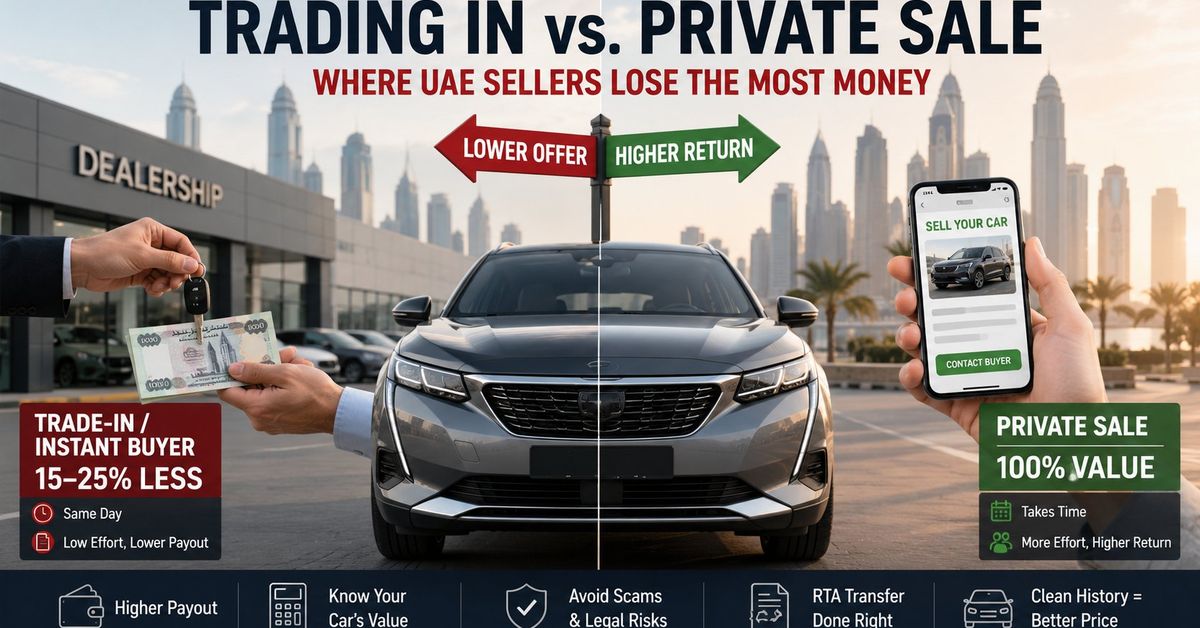
Abu Dhabi: In the used car market, sellers often have a few key decisions to make about how to exit with a good price for their car. Trading in at a dealership, selling through an online platform, or managing a private sale each comes with different results. Generally, the gap between the highest and lowest return can reach AED 20,000 or more on a single car, which compounds significantly for owners who upgrade every few years. It is vital to understand where value is lost to preserve it effectively.
KEY TAKEAWAYS
How much less does a dealer trade-in pay compared with a private sale?
Typically 10 to 20 percent below a realistic private-sale value, in exchange for speed and zero admin.Are instant-buyer platforms better than dealer trade-ins?
Similar in outcome. Both pay roughly 15 to 25 percent below private-sale value for guaranteed, fast settlement.A dealer trade-in typically pays 10 to 20 percent below a realistic private-sale value. Instant-buyer platforms land in a similar range, usually 15 to 25 percent below what a private seller could achieve. The real question is: why the gap?
Dealers need margin, whereas a private sale pays the most but demands the most. The right choice depends on how much a seller’s time is actually worth. For someone upgrading cars every few years in the UAE, that difference adds up to real money over time. If you’re busy, have limited patience for negotiations, or need the cash immediately, trading in or using an online buying service makes sense. 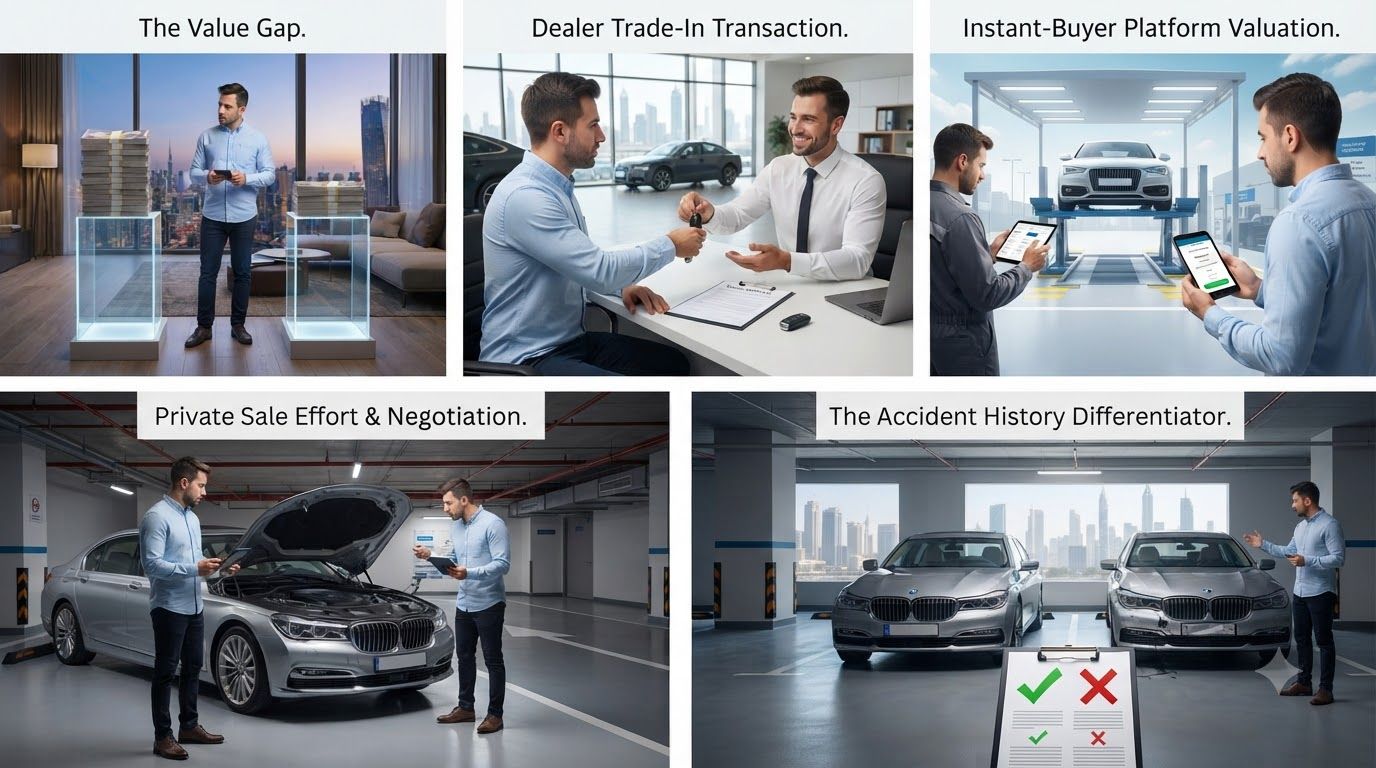
But if you have a few weeks and don’t mind managing the sale yourself, a private sale is almost always worth the effort. It’s worth ten minutes to do the math on your specific car and situation. The payoff could be thousands of dirhams.
The Three Routes
Every seller in the UAE is choosing between the same three options, and each trades money for convenience differently.
|
Route |
Typical Value vs Private Sale |
Speed |
Effort Required |
|
Private sale |
100 percent (the benchmark) |
Weeks, depending on demand |
High: listing, negotiating, screening buyers |
|
Dealer trade-in |
80 to 90 percent |
Same day |
Very low |
|
Instant-buyer platform |
75 to 85 percent |
Same day |
Low |
It is a well-established fact that a car generally loses 9 to 11 percent of its value the moment it is driven out of the showroom and up to 30 percent within the first year, regardless of which route the owner eventually chooses to sell through. However, retaining long-term value varies significantly by model, with research showing which cars hold value after 5 years in the UAE. That baseline depreciation happens either way. The question this comparison actually answers is how much extra is lost on top of that baseline, purely due to the method of sale.
Why Trade-Ins Pay Less
Most dealers are not being unfair when they offer less for a trade-in; they are pricing in their own resale risk and the immediate convenience they are handing the seller.
- The dealer takes on reconditioning costs, holding costs, and the risk that the car sits on the lot longer than expected, all of which get built into a lower offer.
- Trade-in value is often presented as a discount against a new car purchase rather than a straight cash figure, which can make the true gap harder for sellers to see clearly.
- The paperwork, including RTA transfer and loan release if the car is financed, is handled entirely by the dealer, which is the main reason this route remains popular despite the lower payout.


Instant Buyer Platforms
Many online platforms are in a similar bracket to dealer trade-ins but operate independently of a new car purchase.
- Instant-buyer valuations typically reflect the lower end of the market, since these companies need margin to resell the car themselves.These valuation floors are also influenced by overall market supply, a key factor in why used car prices are dropping in the UAE.
- Offers usually land at 75 to 85 percent of a realistic private-sale value, based on cross-platform valuation comparisons, though this varies by car condition, mileage, and demand for the specific model.
- Getting quotes from two or three platforms and comparing the median offer gives a reasonably accurate read on the true wholesale floor for a given car.
The Real Cost
Private sale through online platforms pays the most, but it is not free. The cost shows up as time and risk rather than a percentage deduction.
- A seller needs to benchmark at least 10 to 15 similar live listings to price correctly, since overpricing is one of the most common reasons a private listing sits unsold for weeks.
- Every Salik deduction, traffic fine, and accident remains linked to the seller’s traffic file until the RTA ownership transfer is completed, meaning that private sellers face legal exposure until all paperwork is fully finalised.
- Screening buyers, managing test drives safely, and avoiding payment scams all fall on the seller, unlike a managed service which handles negotiation and RTA transfer for a commission.
- If you have a car valuation certificate, it may give you an official market value figure for better negotiation.
The Accident History Factor
One detail that affects all three routes equally is accident or repair history. A car with a documented accident or repair history typically sells for 40 percent or more below an equivalent undamaged example, regardless of whether it goes through a dealer, a platform, or a private buyer. This makes maintaining clean service and accident records one of the few factors a seller can control that noticeably protects value across every selling method. 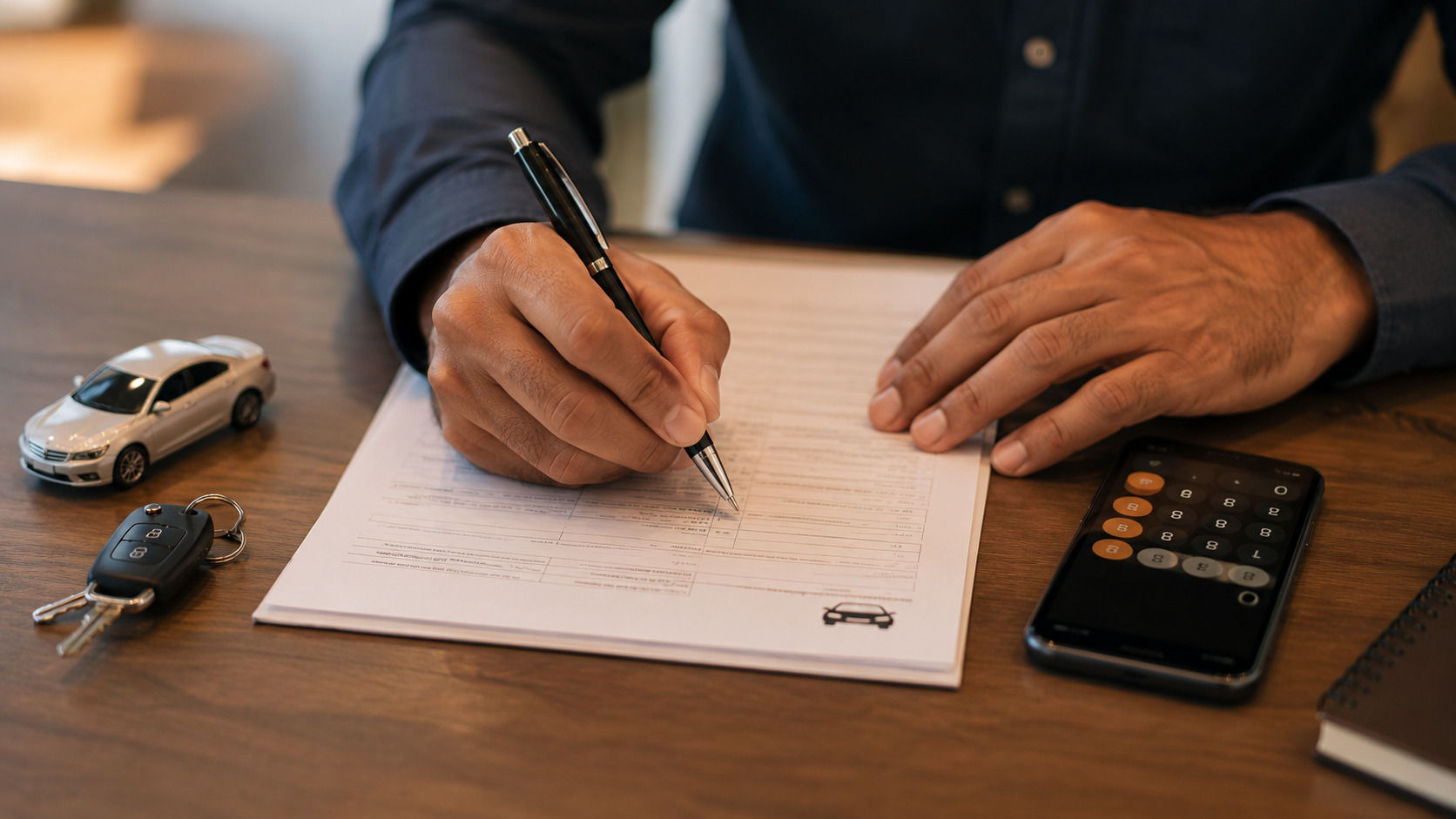
Key Takeaway
As we explain each way to sell your car, each comes with its advantages. However, the gap between trading in and selling privately in the UAE usually comes down to 10 to 25 percent of the car’s value, depending on the route chosen. Sellers who value certainty and zero paperwork, particularly those on a fixed departure deadline, are better served by a dealer trade-in or an instant-buyer platform despite the lower payout.
If you have a clean service history and a car in a segment with strong private demand, it stands to gain the most from listing privately, provided you are prepared to handle the RTA transfer and buyer screening yourself.
Like always, in the practical world, there is no universally correct choice here, only a trade-off between money and effort that every seller has to weigh for their own situation.
Also Read: New Guide to Buying a Used Car From GCC: Latest Import Fees and Paperwork
Kiran Bajad

Kiran Bajad, a seasoned automotive journalist, writes with clarity and passion, helping readers make sense of a fast-changing car market. Drawing on years of road experience and a deep understanding of global trends, he turns complex industry shifts into practical guidance for everyday buyers.
Read Full Bio-
Nissan Patrol -
Nissan X-trail -
Nissan Kicks -
Nissan X-terra -
Nissan Magnite -
Nissan Pathfinder -
Nissan Altima -
Nissan Patrol Nismo -
Nissan Urvan -
Nissan Z
- Latest
- Popular


- News
- Featured Stories


- Latest
- Upcoming
- Popular
-
 Alert Me When Launched
 -
 Alert Me When Launched
 -
 Alert Me When Launched
 -
 Alert Me When Launched
 -
 Alert Me When Launched
 -
 Alert Me When Launched
-
 Nissan Urvan29 Apr, 2026 .
 -
 Nissan Patrol Nismo01 Nov, 2025 .
 -
 Nissan X-Trail01 Nov, 2025 .
 -
 All New Nissan KICKS 2025 | Arabic01 Nov, 2025 .
 -
 All New Nissan Z Nismo01 Nov, 2025 .
 -
 NISSAN PATROL CCL01 Nov, 2025 .
 -
 Nissan Magnite Walk Around | Arabic01 Nov, 2025 .
 -
 2017 Nissan 370Z04 Jan, 2018 .
 -
 2017 Nissan Navara Pickup04 Jan, 2018 .
 -
 2017 Nissan GT-R Review04 Jan, 2018 .