Digital Treasury Framework Transforms AW Rostamani's Cash Flow Strategy

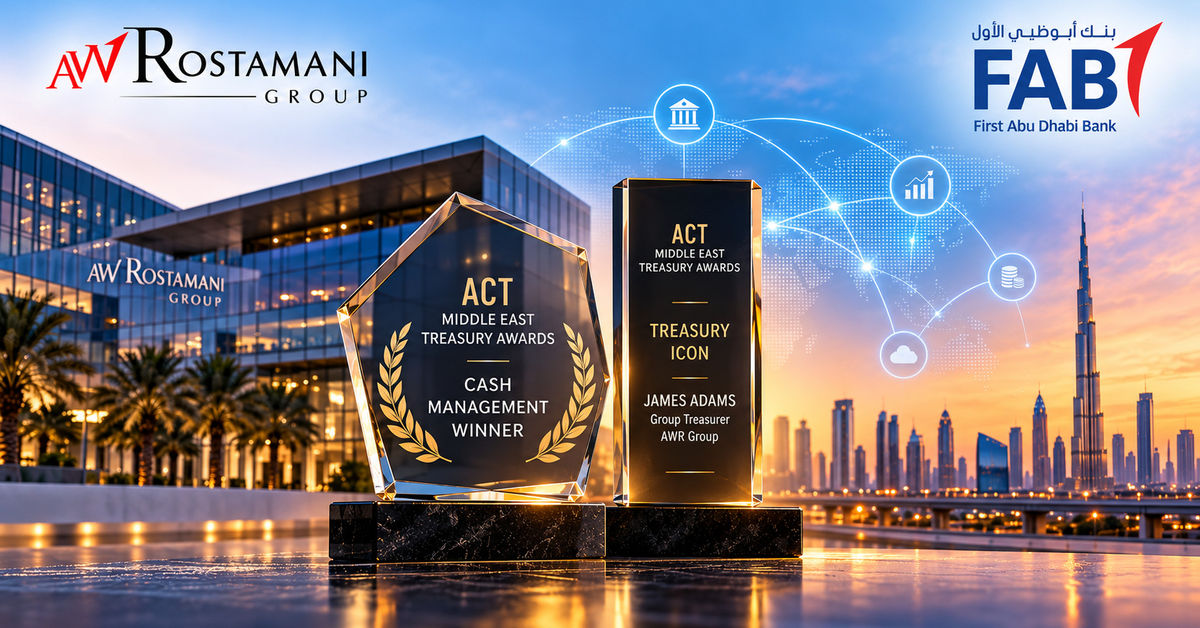
AW Rostamani Group completes a major financial infrastructure overhaul with First Abu Dhabi Bank, establishing a centralised digital treasury that has already earned top industry honours.
KEY TAKEAWAYS
What is AW Rostamani Group’s digital treasury transformation?
It is a group-wide financial overhaul with FAB that introduces centralised cash management, virtual accounts and an integrated treasury system.Which awards did AW Rostamani Group receive for its treasury transformation?
AW Rostamani Group won the Cash Management award at the ACT Middle East Treasury Awards, while Group Treasurer James Adams received the Treasury Icon award.AWR Group's shift from a fragmented, decentralised banking structure to an integrated digital treasury model strengthens operational efficiency and liquidity visibility across its automotive and diversified business units. For a name synonymous with some of the region's most recognised automotive brands, this back-office transformation is as strategic as any new model launch. It signals a wider industry pressure for the UAE's large family-owned conglomerates and major dealership groups to modernise financial infrastructure. It isn't just an option anymore.
The Transformation Scope
AW Rostamani Group, in a key partnership with First Abu Dhabi Bank, has fundamentally re-engineered its group-wide cash management infrastructure. The programme moved the diversified conglomerate away from a traditional, decentralised banking structure that relied on a complex web of multiple physical bank accounts across its various businesses. In its place is a new, integrated treasury model built for real-time intelligence and control. This isn't a minor tweak; it’s a strategic overhaul of the group's entire financial backbone.
At the core of the transformation is the establishment of AWR Group's first In-House Bank. This central hub is equipped with advanced Payment-on-Behalf-Of (POBO) and Receipt-on-Behalf-Of (ROBO) capabilities, enabling centralised payments and collections across all participating entities. The complexity of numerous physical accounts has been replaced by a streamlined virtual account structure. This standardisation has a direct operational impact, with more than 80 per cent of applicable reconciliation rules now harmonised, which in turn has strengthened automation across critical treasury processes including supplier and payroll payments.
Real-time Liquidity Visibility
The single greatest operational gain from this transformation is live, consolidated visibility of cash and liquidity. For a group like AW Rostamani, with significant interests in the capital-intensive automotive sector alongside its other retail and service ventures, that complete financial picture is critical. It allows for smarter working capital management and far faster decision-making on cash deployment. It reduces the inefficiency of idle cash balances sitting in disparate accounts. While individual businesses maintain their operational flexibility, the group's treasury now has a unified command centre.
The impact was articulated by Wayne Beifus, the Group's Chief Financial Officer, who stated the transformation created "significantly better visibility over liquidity across the Group". Beifus also noted the project delivered "stronger controls and a more efficient operating model". This isn't the end of the journey. The new platform is a foundation for future development, with subsequent phases planned to introduce further liquidity centralisation, enhanced cash flow analytics, and AI-enabled forecasting capabilities.
Industry Recognition & Framework
The project's successful execution has already received high-profile validation from the Association of Corporate Treasurers (ACT), a key industry body. At the recent ACT Middle East Treasury Awards, AW Rostamani Group won the coveted Cash Management award. It's a significant endorsement. In addition, a personal honour was bestowed upon Group Treasurer James Adams, who received the prestigious 'Treasury Icon' award for his leadership on the initiative.
These accolades underscore a framework that serves as a regional benchmark. The In-House Bank and virtual account model enable tangible efficiencies that go straight to the bottom line, from reduced banking fees to faster intercompany settlements and more effective cash pooling. For large GCC conglomerates, particularly those managing complex automotive franchises with significant working capital requirements, the strategic implication is clear. The future of effective treasury management is centralised, digital, and deeply integrated. It’s about building a financial engine as modern and efficient as the vehicles in the showroom.
- Latest
- Popular











- News
- Featured Stories









- Latest
- Upcoming
- Popular
-
 Dodge Durango 2026Price coming soon
 -
 Subaru Crosstrek HybridPrice coming soon
 -
 Mercedes-Benz S ClassPrice coming soon
 -
 Toyota Land Cruiser FJPrice coming soon
 -
 Jaecoo J8 SHSPrice coming soon
-
 Alert Me When Launched
 -
 Alert Me When Launched
 -
 Alert Me When Launched
 -
 Alert Me When Launched
 -
 Alert Me When Launched





-
 Zeekr 9X14 Jul, 2026 .
 -
 Volvo EX9016 May, 2026 .
 -
 Volvo XC9016 May, 2026 .
 -
 DONGFENG Mega15 May, 2026 .
 -
 DONGFENG 00715 May, 2026 .
 -
 Dongfeng Huge15 May, 2026 .
 -
 DONGFENG15 May, 2026 .
 -
 iCaur03T13 May, 2026 .
 -
 2713 May, 2026 .
 -
 chevrolet Corvette Zo611 May, 2026 .