ADNOC Fuel Prices Expected Trend for 2026

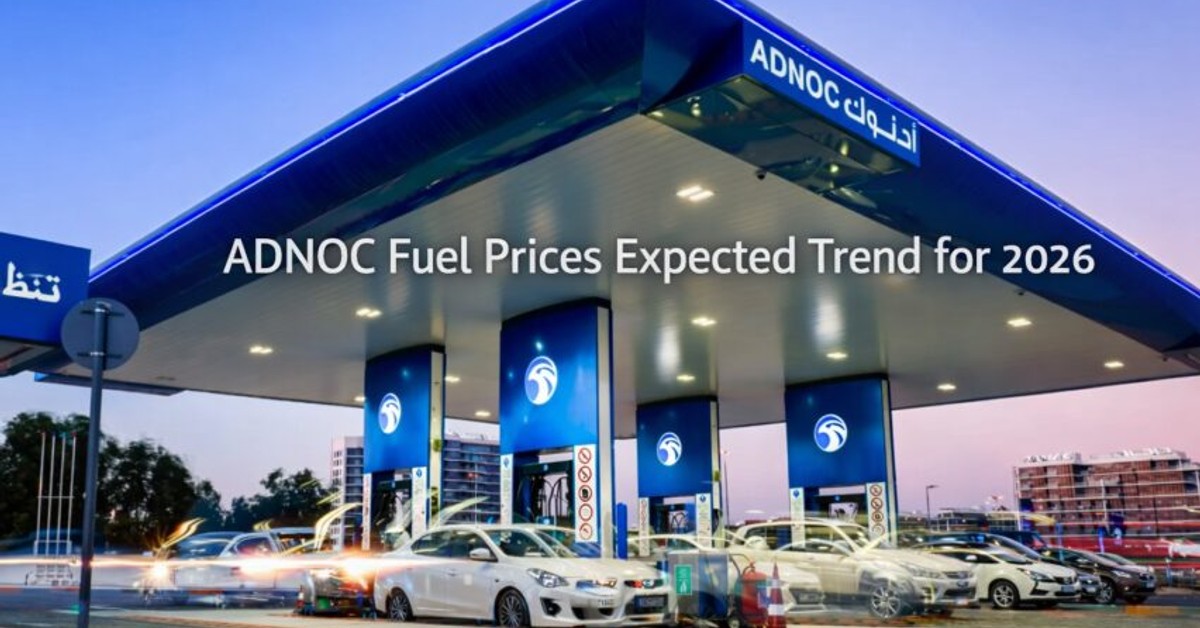
It is a well-known fact that ADNOC plays a vital role in the UAE automotive market. Being the country's largest and dominant fuel retailer and service provider through its ADNOC Distribution subsidiary, it operates over 800 stations nationwide, supplying fuel, lubricants, and convenience services to more than 9 million registered vehicles.
KEY TAKEAWAYS
Will fuel prices continue to drop in 2026?
The market is dynamic, and fuel prices are likely to fluctuate during the years.What determines ADNOC fuel prices monthly?
The UAE Fuel Price Committee reviews global refined fuel benchmarks, not just crude oil prices.And the monthly price adjustments set by the UAE Fuel Price Committee directly impact all car drivers, vehicle owners, and commuters, as well as their driving costs. January 2026 started with price cuts, as Super 98 dropped from AED 2.70 to AED 2.53, Special 95 fell from AED 2.58 to AED 2.42, and E-Plus 91 declined from AED 2.51 to AED 2.34.
Diesel saw the largest drop, from AED 2.85 to AED 2.55. For a 60-litre tank, you are saving AED 10.20 on Super 98. That matters when you're filling up twice weekly. So what is the outlook for the new year as far as fuel prices in the Emirates are concerned? We take a look.
Oil Markets Don't Control Your Fuel Bill
This is as simple as it gets: while Brent crude is down about 18% in 2025 and global crude price indicators have dropped nearly 19%, that does not automatically mean retail fuel prices fall in the same way. Moreover, the International Energy Agency expects a growing supply surplus through 2026. In simple economic terms, this should put downward pressure on fuel, but last year proved that is not always the case.
Super 98 started 2025 at around AED 2.61 per litre, and by December it was at AED 2.70, slightly higher despite falling crude prices. This clearly indicates that what crude oil prices are in the international market is not exactly what you pay at ADNOC stations.
It all depends on the UAE Fuel Price Committee, which reviews prices monthly based on global refined fuel benchmarks, which are different from crude benchmarks. Refined fuel costs are determined by several factors, including crude oil prices, refining margins, transportation, and operating costs. When refining margins increase, which appears to have been the case in late 2025, retail prices can rise even when crude falls.
Actually, refining margins reportedly hit multi‑year highs in late 2025, according to global energy agencies and industry reports. At the same time, refinery outages in some regions and tighter fuel regulations pushed production costs up. That made petrol and diesel more expensive to produce, so the crude price decline did not fully offset these refining cost increases.
Price Movement in 2025 and the Beginning of 2026
|
Month |
Super 98 |
Special 95 |
E-Plus 91 |
Diesel |
Notable Event |
|
Jan 2025 |
AED 2.61 |
AED 2.50 |
AED 2.43 |
AED 2.73 |
The year started moderately. |
|
Oct 2025 |
AED 2.77 |
AED 2.63 |
AED 2.55 |
AED 2.84 |
Peak prices |
|
Dec 2025 |
AED 2.70 |
AED 2.58 |
AED 2.51 |
AED 2.85 |
Still elevated |
|
Jan 2026 |
AED 2.53 |
AED 2.42 |
AED 2.34 |
AED 2.55 |
Sharp decline |
Risks Driving Fuel Price Increases
There are several factors could reverse January's price cuts as we move in the year
- Refinery breakdowns: This is an obvious factor in supply constraints. When big factories that make petrol shut down, less fuel is available, which equals higher prices, even if crude oil stays cheap.
- Shipping problems: Another thing that can disrupt supply is any trouble through the Hormuz Strait or Red Sea that delays tankers, adding transport costs to your pump price.
- OPEC cuts supply: too much oil? OPEC+ may choose to reduce production to push prices back up.
- Summer road trips: Everyone drives more in June-August, demand spikes, and prices climb. This is cyclical in nature, but one big factor that never fails to affect the prices.
What Keeps UAE Fuel Affordable
But chances are prices may stay stable or decline; 2026 prices rest on supply fundamentals:
- Too much oil: IEA is predicting more supply than demand through 2026, pushing crude prices down, and this is one big possibility.
- Weak economy: Global slowdown and China's slower growth mean less demand driving worldwide. That may affect prices and bring them down.
- Additional refining capacity: New or expanded refineries coming on stream tend to ease refining bottlenecks and can compress margins over time.
- Gradual EV adoption: More UAE drivers switching to electric vehicles slightly reduces petrol and diesel demand, which is a minor but real factor.
Last Year's Price Swings Explained
Last year, Super 98 went from AED 2.61 in January 2025 to AED 2.77 in October, a 0.16 increase over nine months. Then it dropped 0.24 in three months to AED 2.53 in January 2026. This up‑and‑down pattern makes budgeting hard for an average car user.
How will these fluctuations impact your driving pattern and cost?
Take a daily 100 km commute. A car averaging 12 km/litre uses nearly 250 litres monthly. At the October peak of AED 2.77, that is about AED 692.50. In January 2026, with Super 98 at AED 2.53, the same usage cost about AED 632.50. A monthly saving of roughly AED 60 and around AED 720 yearly is meaningful for most families.
It is obvious that prices can swing quickly in both directions. Drivers who assumed that cheaper crude automatically meant cheap fuel were disappointed in 2025. The same risk exists in 2026 if you assume prices will stay low all year.
2026 Fuel Price Scenarios
As the new year has just begun, there will almost certainly be ups and downs, and it is better to expect volatility than only steady declines. January's price cuts are a positive indication of broadly favourable conditions: softer crude, more balanced refining margins, and slightly weaker demand growth. But these conditions may not remain constant through 2026.
Likely scenarios
Scenario 1: Prices may stay range-bound between AED 2.30 and 2.60 for Super 98 with monthly fluctuations. While surplus supply keeps a floor under prices, refining costs prevent steep declines. There is about a 40% probability of this happening.
Scenario 2. It is possible that prices will gradually decline to the AED 2.20-2.40 range by year-end as the supply surplus improves and refining capacity increases. The likelihood of 35% of this situation.
Scenario 3: There could also be a price recovery to the AED 2.60-2.80 range due to various factors such as geopolitical issues that may cause disruptions or production cuts, but this outcome has less than a 25 per cent possibility.
But what certainly is not likely to happen is sustained prices below AED 2.20 for Super 98. Even with crude around $70/barrel, refining margins, transportation, and operating costs will not allow prices to fall below the current UAE pricing framework.
Practical Tips for Fuel Savings
As a car user or someone who is a regular buyer of fuel, what should your strategy be to get less shock and save as much as possible? There are several things, like, what about starting with a budget, assuming an AED 2.50 average for Super 98 in 2026? If prices stay lower, treat it as a real benefit. But don't assume January's prices represent the new normal.
It is necessary to consider fuel consumption when buying cars. The difference between a vehicle averaging 10 km/litre versus 15 km/litre matters more at AED 2.50/litre, and so that could be a deciding factor for your next car. At 20,000 km annual driving, that's 2,000 litres versus 1,333 litres, a 667-litre difference costing AED 1,667 annually.
Also, it is smart to consider using the ADNOC Rewards programme. It helps you earn points on fuel purchases and provides consistent savings. This can be done by downloading the app and using it regularly.
One natural thing to do is fill the tank when prices are low. If the February announcement shows increases, fill your tank on the last day of January. That savings compounds over multiple months.
Lastly, it pays you back by maintaining your car very diligently and very properly. It is consistent but pays you back handsomely. Maintain your vehicle properly because poor maintenance reduces fuel efficiency. Or get Cars with the Lowest Maintenance costs to save on the overall ownership costs, too. Things like cleaning air filters, proper tyre pressure, and regular servicing boost mileage by 5-10%. At 3,000 annual litres, that's 150-300 litres saved, worth AED 375-750 yearly.
Conclusion
Right at the beginning of 2026, looking at ADNOC‑linked fuel price trends, it is clear that many moving parts influence the final price you pay. While fuel prices came down reasonably in January 2026, instability and month‑to‑month swings are likely to persist. Brent crude may fall, but retail prices at UAE pumps do not always move in lockstep because refining margins, regional supply issues, and operating costs also play a major role. A reasonable working assumption is that Super 98 could move within a band roughly around AED 2.30 to 2.60 through 2026, with some risk of short‑term spikes. That means car owners should budget cautiously and focus on fuel efficiency, driving habits, and maintenance rather than expecting a straight line of continued low prices.
Kiran Bajad

Kiran Bajad, a seasoned automotive journalist, writes with clarity and passion, helping readers make sense of a fast-changing car market. Drawing on years of road experience and a deep understanding of global trends, he turns complex industry shifts into practical guidance for everyday buyers.
Read Full Bio-

Nissan Patrol -
Nissan X-trail -

Nissan Magnite -

Nissan X-terra -

Nissan Kicks -
Nissan Pathfinder -
Nissan Altima -

Nissan Patrol Nismo -
Nissan Urvan -

Nissan Z
- Latest
- Popular










- News
- Featured Stories







- Latest
- Upcoming
- Popular


-
 Alert Me When Launched
 -
 Alert Me When Launched
 -
 Alert Me When Launched
 -
 Alert Me When Launched
 -
 Alert Me When Launched
 -
 Alert Me When Launched



-
 Nissan Urvan29 Apr, 2026 .
 -
 Nissan Patrol Nismo01 Nov, 2025 .
 -
 Nissan X-Trail01 Nov, 2025 .
 -
 All New Nissan KICKS 2025 | Arabic01 Nov, 2025 .
 -
 All New Nissan Z Nismo01 Nov, 2025 .
 -
 NISSAN PATROL CCL01 Nov, 2025 .
 -
 Nissan Magnite Walk Around | Arabic01 Nov, 2025 .
 -
 2017 Nissan 370Z04 Jan, 2018 .
 -
 2017 Nissan Navara Pickup04 Jan, 2018 .
 -
 2017 Nissan GT-R Review04 Jan, 2018 .